

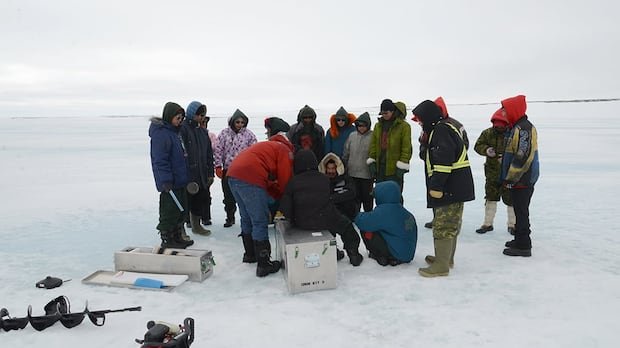

Candice Sudlovenick finds fulfillment in her role as an outreach programs manager at SIKU. She first engaged with Ikaarvik as a young person more than ten years ago and attributes her passion for research to that experience. Reflecting on her time at Ikaarvik, Sudlovenick expressed how empowering it was and how it helped her recognize her own voice and the willingness of others to listen.
The integration of Inuit leadership in research is explored in a recent publication in Arctic Science, co-authored by Danielle Nowosad, a postdoctoral fellow at the University of Calgary of Métis descent. Nowosad highlighted Canada’s efforts towards inclusivity by incorporating Indigenous perspectives and knowledge.
Ikaarvik originated when a cohort of Inuit youths completed the Environmental Technology Program at Nunavut Arctic College in Pond Inlet in 2010. Motivated to extend their environmental efforts beyond the classroom, they formed the organization with the aim of preparing fellow Inuit youth for careers that bridge traditional Inuit knowledge with scientific research.
Sudlovenick emphasized the shift from viewing Inuit individuals solely as camp support to recognizing their broader contributions. Nowosad noted the long-standing advocacy by Inuit communities for more meaningful participation in research. While Western science and Inuit Qaujimajatuqangit (traditional knowledge) are often perceived as distinct, Nowosad pointed out their shared rigor and highlighted the added level of respect embedded in traditional knowledge.
Despite advancements in collaboration, challenges persist, according to Nowosad and Sudlovenick. They cited mismatches in timelines and priorities between academic institutions and community-based work. Acknowledging the importance of nurturing relationships with communities, Nowosad stressed the value of longer-term, intentional research efforts.
With the Arctic region experiencing accelerated climate change, the significance of incorporating local knowledge is increasingly recognized by researchers and community leaders. Sudlovenick emphasized the importance of valuing Indigenous knowledge on par with Western science to empower youth in northern communities. As younger generations grow up embracing both technological advancements and traditional wisdom, the divide between Western science and Inuit Qaujimajatuqangit is expected to diminish.
In conclusion, the collaborative efforts between traditional knowledge and scientific research hold promise for a more inclusive and impactful future in Arctic research.