

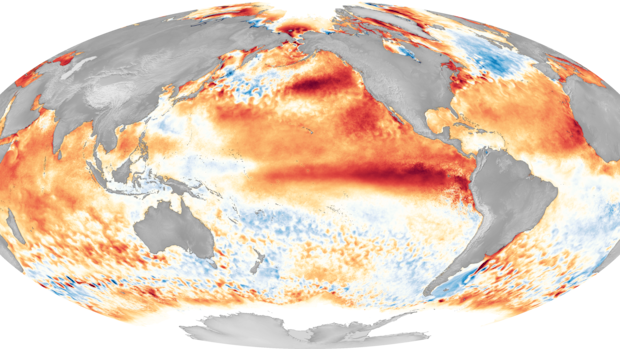

In the realm of climate predictions, discussions are circulating about the potential emergence of an intense El Niño phenomenon, commonly referred to as a “super” El Niño, in the upcoming months. This occurrence is projected to elevate the global temperature and intensify extreme weather patterns.
Numerous climate models are indicating a robust El Niño event set to initiate around June or July and peak in November. Some models even suggest that ocean temperatures in a key Pacific region could soar up to 2 degrees Celsius above the norm. El Niño is a component of the broader El Niño-Southern Oscillation (ENSO) system, impacting weather systems worldwide. Warmer ocean temperatures in the specific Pacific region known as Niño 3.4 trigger El Niño, while colder conditions signal La Niña, with a neutral phase also present.
The U.S. National Oceanic and Atmospheric Administration (NOAA) has issued its monthly ENSO update, signaling an 82% likelihood of El Niño formation between May and July, with a 96% chance of continuation from December to February. Nevertheless, there remains uncertainty regarding the peak intensity of this El Niño event.
Under normal circumstances, trade winds push warm water from South America towards Asia in the Pacific Ocean. However, during El Niño, these winds weaken, leading to a reversal of this process. While a potent or potentially ‘super’ El Niño may unfold this year, experts suggest minimal direct impacts on Canada this summer, although global repercussions are expected.
Winter typically bears the brunt of El Niño effects in Canada, with warmer winters anticipated, particularly in Eastern and Central Canada. The country witnessed its warmest winter on record during the last El Niño episode, with a temperature anomaly of 1.5 degrees Celsius. Forecasts hint at an anomaly of around 2 degrees Celsius or higher for the upcoming El Niño event.
Climate scientists emphasize that the convergence of El Niño and ongoing global warming trends portends a record-breaking year in 2027. They stress that while El Niño may induce extreme conditions, the primary concern remains climate change. Continued reliance on fossil fuels amplifies the influence of climate change on extreme weather events, surpassing the impact of natural climatic variations.
El Niño-driven weather extremes, such as heavy rainfall, droughts, and heatwaves, are expected to escalate globally. While El Niño typically dampens hurricane activity in the Atlantic, it could heighten wildfire risks in regions already grappling with drought, such as Western Canada. Experts caution that vigilance is crucial, as El Niño has historically correlated with increased fire hazards in Canada and neighboring regions due to climate change effects.