

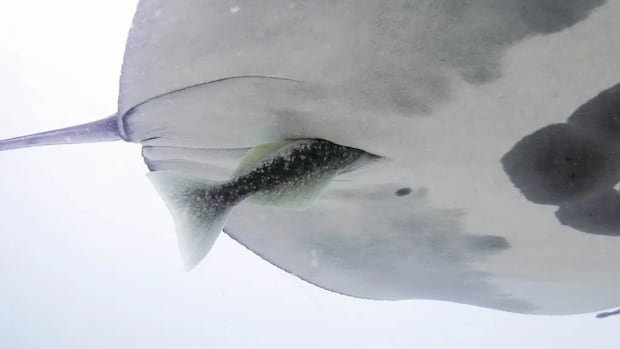

Suckerfish, known as remoras, are not always the most polite companions during their oceanic travels. These small fish hitch rides by attaching themselves to larger marine animals like sharks, whales, and manta rays, feeding on parasites in exchange for the journey. However, recent research indicates that there might be drawbacks for manta rays when accompanied by remoras.
According to marine researcher Emily Yeager from the University of Miami, these fish have been observed engaging in what is termed “cloacal diving,” where they dive into the cloaca of their hosts, a multifunctional orifice for reproduction and excretion. While this behavior has been seen before between remoras and whale sharks, this study marks the first documented evidence of such interactions between remoras and manta rays.
The study, published in the journal Ecology and Evolution, highlights seven instances of this phenomenon across different locations and over a 15-year period, suggesting that it may be more common than recorded. Yeager speculates that this behavior could be triggered by fear in remoras, as seen in a video where a remora startles and dives into a manta ray’s cloaca, causing the ray to react violently before continuing its course.
Brooke Flammang, a biological sciences professor at the New Jersey Institute of Technology, suggests that the remoras might be engaging in coprophagy, or the consumption of feces, while seeking a food source. Flammang notes that remoras can be territorial when sharing space on a host.
Although it is unclear how manta rays feel about this intrusion into their personal space, Yeager warns that such behavior could potentially harm the rays, especially if suction cups cause skin damage in sensitive areas like the cloaca. This could impact reproduction and waste excretion over time, complicating the traditional categorization of the relationship between remoras and manta rays as symbiotic or commensal.
In light of these findings, Yeager emphasizes that natural relationships are not always easily defined and may exist on a spectrum, reflecting the complexities of interactions in nature.