

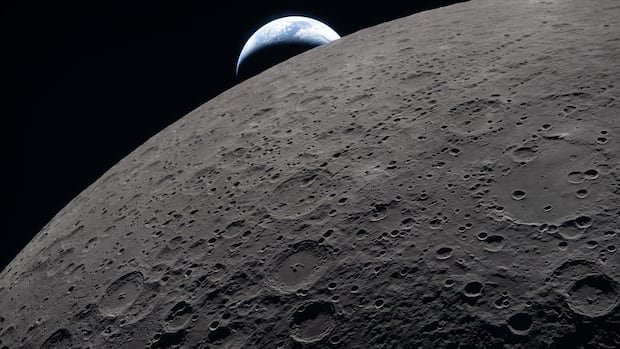

The crew of Artemis II is on their way back home after a groundbreaking journey to the moon. Canadian Space Agency astronaut Jeremy Hansen and NASA astronauts Reid Wiseman, Victor Glover, and Christina Koch set a new record by venturing farther from Earth than any humans ever have as part of the Artemis II mission.
While satellites have long captured images of the moon’s far side, dating back to Luna 3’s first photos in 1959, Artemis II enabled humans to see some of these regions directly for the first time. Kelsey Young, NASA’s Artemis II lunar science lead, expressed excitement about allowing astronauts to witness and describe lunar features firsthand, highlighting the unique capabilities of the human eye in making nuanced color observations.
During a media conference, the astronauts spent five hours making observations using both cameras and the naked eye. They provided detailed descriptions of what they saw, focusing particularly on areas like the Orientale basin and color variations near Hertzsprung crater on the moon’s far side.
Contrary to common belief, the moon does exhibit color, originating from the diverse minerals on its surface. The human eye, being more sensitive than a camera, can discern subtle differences in color and brightness without the need for saturation adjustments. Ralph Chou, a professor emeritus at the University of Waterloo, emphasized the eye’s superior ability to detect and differentiate visual cues compared to electronic systems.
Moreover, the astronauts also witnessed meteoroids striking the moon’s surface during the flyby, a phenomenon rarely observed on Earth due to atmospheric interference. These impact flashes, reported by the astronauts, offer insights into transient events that cameras may miss, showcasing the value of human observations in space exploration.
Overall, the combination of visual and camera observations during the Artemis II mission promises to enhance our understanding of the moon and its geological features. NASA’s chief exploration scientist, Jacob Bleacher, lauded the crew’s descriptions of the lunar views, emphasizing the scientific significance of the mission’s findings.