

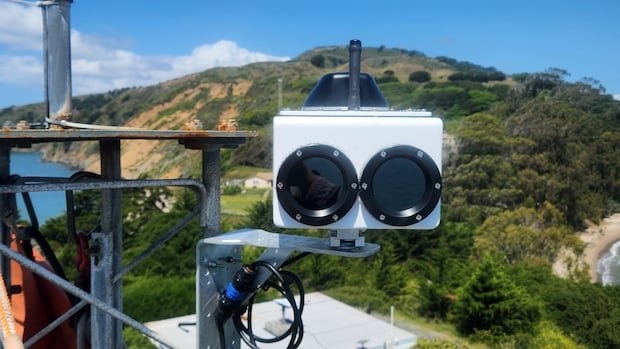

Marine scientists in British Columbia are exploring a novel approach to whale monitoring inspired by a successful initiative in California, aiming to reduce whale collisions in local waters. In San Francisco Bay, a collaboration between researchers, ferry operators, and the public has been established to track whale movements using innovative technology.
The WhaleSpotter cameras, compact thermal imaging devices enclosed in white boxes, are deployed in strategic locations to observe whale activities round the clock. These camera sightings, combined with human observations, are integrated into a public app for collective monitoring. According to Daniel Zitterbart, the chief scientist at WhaleSpotter, increasing surveillance on the water enhances whale protection efforts.
While WhaleSpotter cameras are operational in British Columbia, they are currently stationed on land only, limiting their range to about two nautical miles. The primary goal is to detect whale presence and prevent vessel strikes, a pressing issue in the region highlighted by recent incidents involving humpback and orca whales.
In San Francisco Bay, the WhaleSpotter cameras are synced with the Whale Safe app, allowing a broad spectrum of stakeholders, including scientists, mariners, and the public, to access real-time whale sightings. This collaborative effort, as mentioned by Douglas McCauley, director of the Benioff Ocean Science Laboratory, underscores the importance of community engagement in developing a shared resource.
Thomas Hall from the San Francisco Bay Ferry emphasized the significance of utilizing ferry-mounted cameras to track whale behavior systematically. The long-term objective is to establish patterns of whale activity to optimize ferry routes accordingly. Zitterbart advocates for the integration of similar camera systems on all B.C. Ferries routes to safeguard the whales’ migratory pathways effectively.
In response to the escalating concern over whale strikes, B.C. Ferries is considering implementing detection devices on their northern route following a fatal incident involving a humpback whale. The aim is to expand this initiative to other routes progressively.
Efforts to enhance whale protection have gained momentum amidst rising ship traffic and changing whale migration patterns due to climate change. Researchers in San Francisco Bay have witnessed an increase in grey whale sightings as these marine mammals seek new feeding grounds during their northern migration.
Vessel strikes pose a significant threat to whales, prompting urgent action. Conservation biologist Sean Brillant emphasizes the necessity of collaboration across borders to address the global issue of whale conservation effectively. Sharing data among various agencies is crucial for successful conservation initiatives worldwide.