

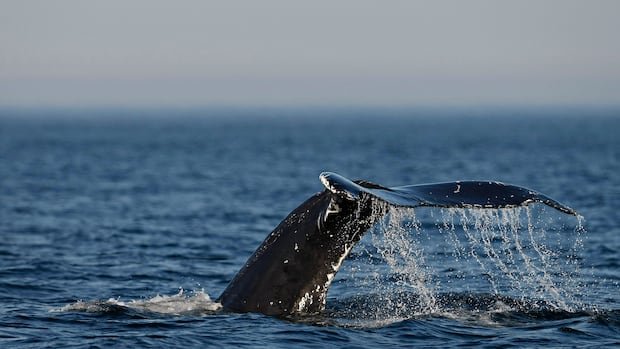

As the temperature of the Gulf of St. Lawrence rises, recent Canadian research indicates a shift in the dietary habits of certain baleen whales. The alteration in their diets is attributed to changes in the available food sources. Lead researcher Charlotte Tessier-Larivière from Université du Québec à Rimouski highlighted the decrease in Arctic krill, a crucial prey item for fin whales in the 1990s.
Tessier-Larivière’s study reveals that fin and minke whales have transitioned to consuming more forage fish like capelin, mackerel, and herring, which are the primary diet of humpback whales in the region. According to Tessier-Larivière, the research demonstrates the whales’ ability to adapt their diet based on the varying availability of preferred prey, signifying a positive adaptive capacity that remains incompletely understood.
The evolving dietary patterns of these whale species raise concerns about potential competition for food resources and the repercussions if the prey species experience a decline in numbers. Hanna Vatcher, a campaigner at Oceana, expressed both encouragement for the whales’ adaptive behaviors and distress over the broader implications of the changing marine environment due to climate change.
Analyzing samples collected over 28 years during the summer months, the study investigated the isotopic composition of tissues from the whales and their prey. The findings indicate an increase in forage fish signatures in the tissues of fin, minke, and humpback whales in recent years, underscoring the significance of these fish species in the marine ecosystem.
Despite consuming similar types of fish, the study observed a phenomenon called “resource partitioning,” where the whales exhibit distinct feeding behaviors to mitigate competition in a limited food supply scenario. The adaptive nature of these intelligent beings, as noted by Janie Wray from BC Whales and North Coast Cetacean Society, involves adjustments in feeding strategies based on prey availability.
Wray’s recent study on bubble net feeding by humpback whales elucidated the sophisticated techniques employed by these whales for hunting. Collaborative behaviors between humpbacks and fin whales in foraging activities have also been observed, suggesting a strategic approach to accessing food resources without direct competition.
Emphasizing the importance of studying whale behavior for effective marine conservation, Wray highlighted the need to identify critical habitats based on whale activity. She stressed the significance of protecting these areas to ensure the well-being of whale populations and the preservation of marine ecosystems in the face of ongoing environmental changes.
The study area in the Gulf of St. Lawrence is not within a marine protected area, although efforts are underway to expand existing protected zones. Vatcher emphasized the necessity for Canada to adopt dynamic conservation strategies, considering the adaptive nature of whales and the evolving marine environment influenced by climate change. Adaptive management approaches informed by climate data and predictive models are deemed essential for safeguarding whale populations and their habitats in the future.