

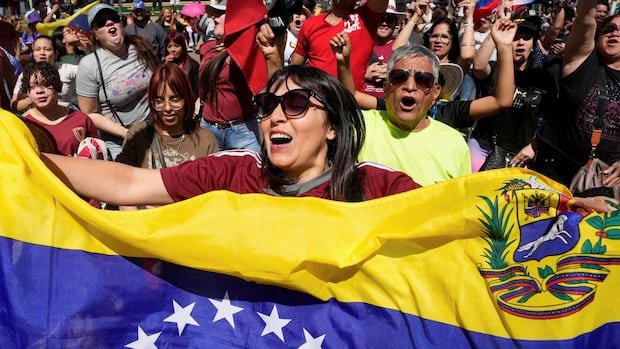

Venezuelan migrants across the globe erupted in jubilation on Saturday after President Nicolas Maduro was captured by a U.S.-led operation. Maduro’s regime oversaw one of the largest mass migrations in recent history, prompting celebrations among Venezuelans in Chile’s capital.
“We are finally free. The dictatorship has crumbled, and we have a liberated nation,” expressed Khaty Yanez, a Venezuelan resident in Chile for seven years. Her compatriot, Jose Gregorio, echoed the sentiment, declaring it a day of freedom after years of struggle and hardship.
According to the U.N. International Organization for Migration, approximately 7.7 million Venezuelans, constituting 20% of the population, have left the country since 2014 due to food scarcity and the pursuit of better opportunities abroad. Neighboring Colombia has welcomed the largest share of Venezuelan migrants, with around 2.8 million, followed by 1.7 million in Peru.
In Lima, Peru, Venezuelan nationals gathered draped in their country’s flag to celebrate Maduro’s capture. The Peruvian President announced plans to facilitate the return of Venezuelans, irrespective of their immigration status, emphasizing the inclusivity of the repatriation process.
While the U.S. was previously a sanctuary for Venezuelans, during Donald Trump’s presidency, many were compelled to seek refuge elsewhere. In Spain, thousands assembled in Madrid to witness Trump’s press conference live, while similar celebrations were anticipated in Buenos Aires, Argentina.
Following the initial elation, concerns about Venezuela’s future emerged among Venezuelans abroad. Andres Losada, a resident in Spain, expressed a mix of anxiety and joy about the developments in Venezuela, hoping for a brighter future for the country and its citizens.
Despite uncertainties, Venezuelans remain optimistic about the prospect of freedom and change. Venezuelan security forces maintained a presence in Caracas, the capital, as residents monitored the situation closely, preparing for potential challenges ahead.
Agustin Rodriguez, vice president of a Venezuelan cultural association in Spain, acknowledged the necessity of the strikes that led to Maduro’s capture, emphasizing the need for a transition towards a future with power alternation and stability.
The global response to Maduro’s capture has been mixed, with Venezuelans expressing a range of emotions from relief to apprehension about what lies ahead for their country.