

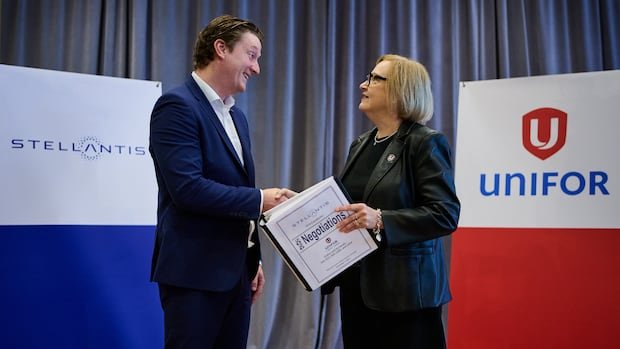

The labor union representing employees at Stellantis has cautioned the American automaker against overlooking Canadian workers as negotiations between Unifor and the company commenced on Tuesday. Unifor is engaging in contract discussions with the Detroit Three automakers, employing a pattern bargaining strategy to establish terms that can be duplicated with other firms. Despite recently approving new collective agreements with Ford Motor Co. and General Motors in Canada, Unifor’s national president Lana Payne highlighted that the most challenging phase lies ahead. Payne acknowledged the obstacles faced due to prevailing uncertainties and external factors, emphasizing that the ongoing negotiations are anticipated to be the toughest yet.
The deadline for reaching a new agreement is set for September 11, with job security being a primary concern for the union following the layoff of over 2,000 workers from Stellantis’ Brampton, Ontario assembly plant, which has been inactive since 2023. Unifor had been informed last month about potential plant closure and sale by Stellantis, disrupting plans for Jeep production. The decision to shift Jeep Compass production to the U.S. was deemed a breach of the existing collective agreement by the union, resulting in the plant’s indefinite closure.
In response, Payne reiterated the necessity of retaining Jeep Compass production in Brampton and criticized Stellantis for its actions, stressing the importance of reinstating operations at the assembly plant. Stellantis acknowledged the significance of the labor discussions, recognizing the industry’s evolving landscape and regulatory challenges. Trevor Longley, Chairman and CEO of Stellantis Canada, highlighted the company’s substantial investments in Canadian operations since 2022, aimed at enhancing manufacturing capabilities and advancing battery technology.
The negotiations are taking place amid U.S. tariffs impacting local automakers, with a 25% tariff on non-U.S.-made vehicles still in effect. Recent threats from U.S. President Donald Trump to escalate tariffs on Canadian automotive imports have intensified the economic strain on the industry. Payne emphasized the critical nature of maintaining Canada’s auto sector amid these challenges and the need to resist such tariff impositions.
Larry Savage, a labor studies professor, highlighted Unifor’s dual efforts in safeguarding Canadian auto manufacturing both at the bargaining table and in lobbying against detrimental trade agreements at the governmental level. Unifor’s successful ratification of new contracts with General Motors was reported, with substantial support from members across various locations. The ratified agreements align with the wage increments secured in the Ford contracts, reflecting Unifor’s strategic pattern bargaining approach within the industry.