

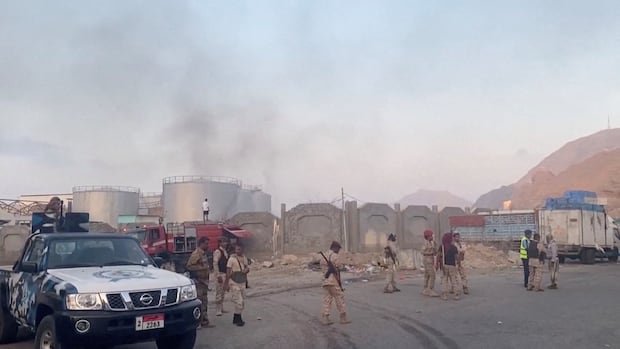

The United Arab Emirates announced on Tuesday its decision to withdraw its remaining troops from Yemen following Saudi Arabia’s support for a request to evacuate the U.A.E. forces within 24 hours, marking a significant crisis between the two Gulf nations and major oil producers. The move came after a Saudi-led coalition airstrike targeted a shipment of weapons from the U.A.E. to separatist forces in the Yemeni port of Mukalla.
This development has heightened tensions in the region, particularly along crucial international trade routes in the Persian Gulf, with Saudi Arabia condemning the actions of the U.A.E. as “extremely dangerous.” The ongoing conflict in Yemen, which has been entrenched in a civil war for over a decade involving various factions and regional powers, continues to face escalating challenges.
Key players in the conflict include the secessionist Southern Transitional Council (STC), backed by the U.A.E., which recently seized control of strategic provinces and oil facilities in southern Yemen. On the other side, the Iran-aligned Houthi rebels control significant territories, including the capital, Sanaa. Additionally, the Yemeni military, aligned with the internationally recognized government and supported by Saudi Arabia, is engaged in the complex dynamics of the conflict.
The latest confrontations have disrupted the fragile peace in Yemen, potentially leading to a new phase in the protracted war, with conflicting factions turning against each other in the impoverished nation. The rift between Riyadh and Abu Dhabi, once close allies in the coalition against the Houthis, underscores diverging interests in Yemen and broader geopolitical shifts in the region.
The origins of the crisis trace back to the initial conflict in 2014 when the Houthis advanced from their stronghold, triggering a broader intervention by Saudi Arabia and the U.A.E. to support the exiled Yemeni government. The recent clashes between the STC, government forces, and tribal allies highlight the complex alliances and rivalries within the broader civil war context.
Recent advances by the STC in capturing key territories and facilities signify a strategic shift in the conflict, with implications for potential negotiations and the future of Yemen. The evolving situation underscores the evolving landscape of regional power dynamics and economic interests between Saudi Arabia and the U.A.E., once pivotal allies in the region.