

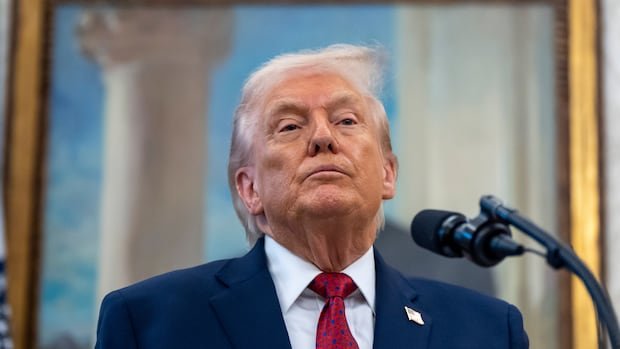

U.S. President Donald Trump took action on Monday by signing an executive order that officially designates fentanyl as a weapon of mass destruction. This decision significantly broadens the U.S. government’s capabilities to combat the synthetic opioid, which has been linked to a high number of overdose deaths in America annually.
The unprecedented classification of fentanyl as a weapon of mass destruction signifies Trump’s determination to address fentanyl not just as a public health emergency but as a serious national security concern comparable to chemical warfare. By escalating efforts against criminal organizations seeking to inundate the U.S. with drugs, this move allows the Pentagon to support law enforcement operations and enables intelligence agencies to utilize specialized tools typically reserved for combating the spread of weapons.
During an event at the White House honoring service members involved in border security along the U.S.-Mexico border, Trump emphasized the gravity of the situation, stating, “We’re formally classifying fentanyl as a weapon of mass destruction, which is what it is. They’re trying to drug out our country.” The executive order issued by Trump also highlights that illicit fentanyl bears more resemblance to a chemical weapon than a conventional narcotic.
However, Democratic House Representative Jim McGovern from Massachusetts criticized the decision, pointing out Trump’s previous pardon of Ross Ulbricht, the founder of the Silk Road marketplace implicated in facilitating substantial drug sales. McGovern raised concerns about the inconsistency in Trump’s actions, citing the pardon of an individual associated with importing fentanyl into the U.S.
Former Republican Congressman Justin Amash criticized the executive order, claiming it represents a manipulation of language to expand governmental authority beyond reasonable limits, akin to previous instances with terms like “emergency,” “terrorist,” and “defensive.”
Trump’s recent classification of drug cartels as foreign terrorist organizations has paved the way for military interventions against them. Since early September, there have been 25 confirmed strikes on suspected drug vessels in the Caribbean and Pacific regions, resulting in the deaths of 95 individuals. The U.S. military disclosed that it engaged three boats allegedly involved in drug smuggling in the eastern Pacific Ocean, resulting in fatalities on each vessel.
Legal experts have raised concerns about the legality of these strikes, citing a lack of public evidence demonstrating the presence of drugs on the boats or the necessity of lethal force. Trump has also hinted at potential military actions on land in countries like Venezuela, Colombia, and Mexico to combat drug trafficking, emphasizing his administration’s focus on reasserting U.S. influence in the Western Hemisphere.
Amid these developments, opioid overdoses continue to claim the lives of tens of thousands of Americans annually. Notably, Mexico serves as a primary source of illicit fentanyl destined for the U.S., with many precursor chemicals for fentanyl production originating from China. While Venezuela is known for its role as a transit point for cocaine from countries like Colombia, Peru, and Bolivia, policy experts emphasize that the majority of fentanyl precursors come from China rather than Venezuela.
In conclusion, Trump’s actions regarding fentanyl and drug trafficking have sparked mixed reactions, drawing attention to the complexities of combating the opioid crisis and illicit drug trade on a national and international scale.