

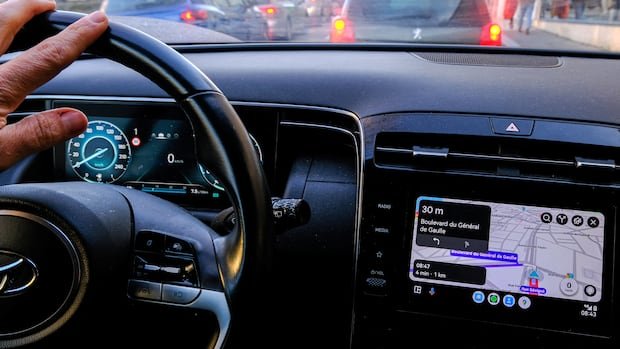

Travel writer Tara McAndrew had a pivotal moment in Wellington, N.Z., when she found herself in a forest instead of at a rental apartment. This experience led her to reconsider her heavy reliance on GPS navigation. Over the past ten years, McAndrew, who is based in Ontario and writes for Travel with TMc, has traveled extensively across the globe. While she uses Waze or Google Maps for directions in unfamiliar cities, she consciously chooses to navigate her way back without technological assistance.
According to McAndrew, balancing technology with manual navigation helps exercise cognitive skills that may diminish with excessive GPS use. While approximately two billion users rely on Google Maps monthly, with millions using Apple Maps or Waze, research indicates that getting lost can benefit brain health and spatial memory. A study conducted at McGill University and published in Scientific Reports in 2020 revealed that regular GPS users exhibited poorer spatial memory, which can deteriorate over time due to increased GPS dependence.
Neuroscientist Louisa Dahmani, who co-authored the study, emphasized the importance of engaging the brain’s hippocampus, responsible for spatial memory, by occasionally navigating without GPS. Spatial-memory loss and cognitive decline can be prevented by staying aware of surroundings even when using GPS and challenging oneself to navigate independently.
In a similar vein, Brenda Holder, a Cree traditional knowledge keeper, emphasizes staying calm when feeling lost in nature. By observing natural cues such as the sun, stars, and mountains, individuals can enhance their wayfinding skills. Holder suggests using multiple navigational clues to ensure accuracy and avoid solely relying on technology, which she believes has contributed to a disconnect between people and the environment.
Recent developments highlight the importance of traditional navigation methods in the face of potential GPS failures. Authorities in Europe are reverting to pre-World War II technologies like LORAN and celestial navigation to mitigate disruptions caused by jammed GPS signals. Katherine Dunn, author of “Little Blue Dot: How GPS Shaped the Modern World,” underscores the necessity of maintaining navigational skills beyond technology dependence.
McAndrew acknowledges the decline in her ability to visualize locations in her hometown as she used to as a child, attributing this shift to reduced reliance on GPS. Reflecting on her past experiences with paper maps and printed directions, she now values the skills gained from manual navigation. Embracing a balanced approach to technology and traditional navigation methods, McAndrew finds herself coming full circle in her travel experiences.