

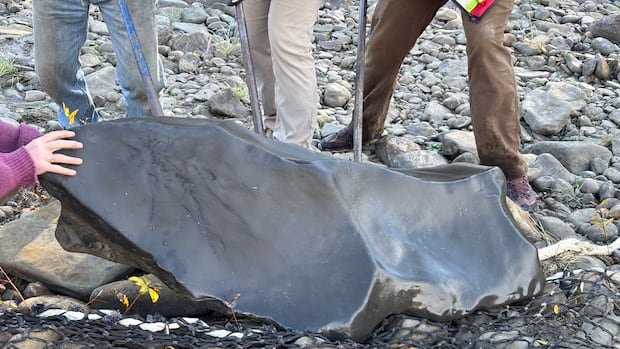

A fossilized skull of an ichthyosaur, a marine reptile, has been unearthed in B.C.’s Kiskatinaw River valley, approximately 52 kilometers south of Fort St. John. The skull was discovered two years ago by local resident Kevin Geist and his 11-year-old son Andreas while exploring the fossil-rich Peace region along the river’s shore.
The ongoing drought over the past four years has led to record low water levels in the Kiskatinaw River, causing more rocks to be exposed. Among these rocks was one containing the ancient skull. Geist mentioned that the drought had exposed more rocks, including the one with the skull, which was not submerged in water.
Initially unsure of the significance of the rock, Geist’s sister-in-law, Diana Hofmann, shared pictures of the discovery with the Tumbler Ridge Museum after revisiting it this summer. Subsequently, the museum confirmed the skull as an ichthyosaur, distinguishing it as a marine reptile resembling a mix of a dolphin and a fish, well-suited for oceanic life and giving birth in the sea.
According to Eamon Drysdale, the museum’s paleontologist, the ichthyosaur likely perished during the Triassic era, although the river valley’s formation dates back to the Cretaceous period when ichthyosaurs were facing extinction. The skull, encased in Triassic carbonate rock, possibly traveled to the valley post-Rocky Mountains formation via glacier movements.
Drysdale highlighted the Peace region’s fossil-rich nature, spanning 500 million years of Earth’s history with diverse fossil finds. He expressed optimism about potential exposed fossil materials due to low water levels, hinting at undiscovered specimens waiting to be uncovered. The careful retrieval of the skull involved an airlift by helicopter and subsequent transportation to the museum.
While partial ichthyosaur remains have been previously found in Tumbler Ridge, complete specimens are rare. The recovery of this significant skull was a collaborative effort involving the Geist family and the local community, showcasing the museum’s reliance on local contributions for fossil discoveries. Drysdale expressed enthusiasm for the insights the specimen could offer about the region’s prehistoric past.