

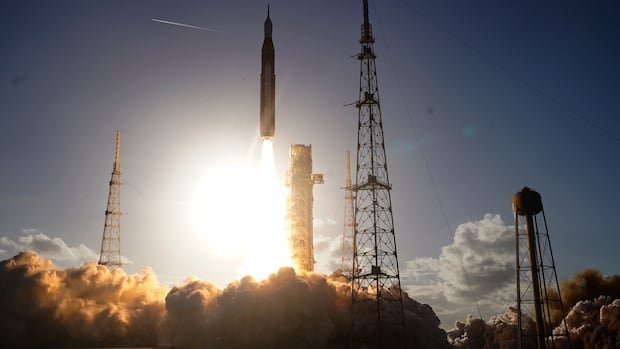

NASA’s Artemis program has garnered attention for its goal to send astronauts in orbit around the moon. However, driving this mission is a larger strategic competition: a fresh rivalry between the United States and China to reintroduce humans to the lunar landscape.
This contest extends beyond planting flags and footprints this time around. The nation that reaches the moon first could secure an edge in selecting ideal locations for future lunar infrastructure, establishing technical benchmarks, and shaping the next phase of space exploration.
During NASA’s recent Ignition event, officials emphasized this urgency explicitly. NASA aims to land Americans on the moon before China does – and before the conclusion of U.S. President Donald Trump’s term.
Jared Isaacman, the billionaire nominated to lead NASA by Trump, highlighted the importance by stating, “NASA has affirmed that we will return Americans to the moon before the end of President Trump’s term. Our primary competitor has set a target before 2030.”
“The distinction between success and failure will be gauged in months, not years.”
Consequently, a political race is underway. NASA is crafting an accelerated agenda to land Americans on the moon by early 2028, while Wu Weiren, China’s lunar program chief designer, has expressed confidence: “By 2030, the Chinese people will surely set foot on the moon. That’s a certainty.”
Casey Dreier, chief of space policy at the Planetary Society, doubts the feasibility of the 2028 timeline but notes that China has become a valuable motivator for NASA and its advocates.
“China has been steadily advancing its lunar spaceflight aspirations,” he remarked. “They have long aimed to land their astronauts on the moon’s surface, establish a lunar base… It serves as a rallying point to garner political support.”
This challenge represents a marathon, not a sprint, compared to previous moon pledges by the U.S. In 2019, then-Vice President Mike Pence pledged a return to the lunar surface by 2024, a deadline that has since passed due to shifting political priorities.
Dean Cheng, a senior fellow at the Potomac Institute for Policy Studies and a seasoned expert on China’s space program, stresses that this new competition is a long-term endeavor. The objective is not merely a moon visit but a sustained presence.
“One notable aspect of the Chinese space program is their commitment to fulfilling their predictions,” Cheng pointed out. “This lends credibility to China’s 2030 target.”
While some view the current situation as a genuine race, Kevin Olsen, a Canadian research fellow at the UK Space Agency, argues that Americans will always be the first to reach the moon. He believes both sides are ultimately headed in the same direction.
Moreover, Olsen emphasizes that Artemis is not solely a U.S. endeavor. Collaborating with the Canadian Space Agency, the European Space Agency, JAXA, and the Japan Aerospace Exploration Agency, NASA’s Artemis initiative transcends nationalism, aiming to benefit all humankind through exploration.
The timing remains crucial, with political factors driving the 2028 goal.
“It is the final year of President Trump’s second term, and there is a strong desire from the White House to achieve this under President Trump,” Dreier explained.
The urgency transcends politics and extends to geography. Both the U.S. and China plan to establish lunar bases near the moon’s south pole. This region is deemed valuable as certain deep craters there are permanently shaded, potentially housing water ice.
The presence of water is critical for various purposes, including drinking, generating breathable oxygen, and producing rocket fuel. Securing access to the most advantageous sites in this region is crucial for the country that lands first.
The emphasis on urgency was palpable at the Ignition event, with Isaacman stressing the need to expedite lunar missions instead of celebrating bureaucratic processes.
The frequency of lunar missions could have long-term implications, as Cheng highlighted. With China potentially establishing a lunar outpost with rotated crews every six months, the U.S.’ less frequent missions may have ramifications beyond prestige.
Cheng speculated, “If there are constant Chinese missions and rare American missions, what makes you think the language of space travel will be English? And it’s not just the literal language like we’re talking. It’s data formats.”
In this context, the nation that establishes the first sustained base may influence the rules and technical standards for subsequent endeavors.
Addressing funding challenges, Dreier pointed out that NASA’s budget today is substantially lower than during the Apollo era. To bridge this gap, NASA is heavily relying on private industry, especially for spacecraft essential for the lunar surface transition.
This reliance has spurred a competition between two billionaire-led companies. Initially tasked with building the lunar lander, SpaceX faced delays, leading NASA to broaden the competition. Both Elon Musk’s SpaceX and Jeff Bezos’s Blue Origin are now striving to ready their vehicles for the mission.
NASA intends to partner with the first provider prepared for the mission, underscoring its dependence on