

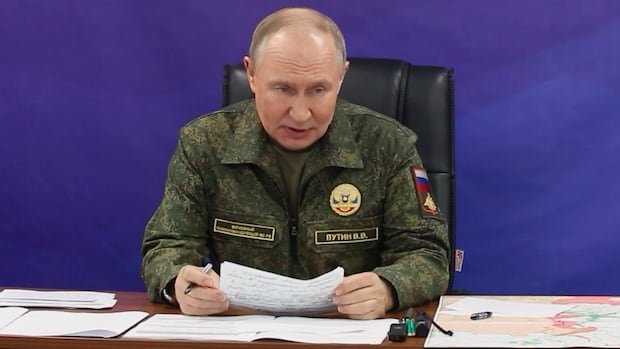

Russia has successfully tested a new nuclear-powered cruise missile designed to evade existing defense systems, signaling its readiness for potential deployment in the country’s military arsenal, as stated by President Vladimir Putin. The missile known as Burevestnik has undergone extensive testing and is part of Russia’s strategic messaging in the face of Western pressure regarding the conflict in Ukraine and warnings against potential NATO strikes deep within Russian territory.
During a recent briefing, a video released by the Kremlin depicted Putin in military attire receiving a progress report from Gen. Valery Gerasimov, detailing that the Burevestnik achieved a significant milestone by covering 14,000 kilometers during a recent test flight. The missile, named storm petrel in Russian, was airborne for 15 hours using nuclear power, with Gerasimov hinting that there is still room for further advancement beyond this achievement.
Although details about the Burevestnik remain scarce, it has been dubbed Skyfall by NATO, with Western experts expressing doubts due to concerns over the reliability of a nuclear engine. Putin had initially disclosed Russia’s development of the weapon in a 2018 address, boasting its purported unlimited range capability to circumvent missile defense systems globally.
Notably, the Burevestnik encountered a setback in August 2019 when it reportedly exploded during testing, resulting in casualties and a brief spike in radioactivity. Despite this incident, Putin emphasized the need for preparing the infrastructure to integrate these advanced weapons within the Russian armed forces, highlighting the missile’s perceived invulnerability and unpredictable flight patterns.
Kirill Dmitriev, a senior aide to Putin, informed U.S. counterparts of the successful testing of the Burevestnik, characterizing it as a groundbreaking weapon class. The recent missile drills conducted by Russia involving strategic nuclear forces underscore the country’s military preparedness, given the ongoing tension in the region. Additionally, Russia’s drone attacks on Ukraine have led to civilian casualties, prompting renewed calls for enhanced defense mechanisms by Ukrainian officials.
The developments surrounding the Burevestnik missile and Russia’s military exercises serve as a testament to the escalating geopolitical tensions in the region, with implications for global security dynamics.