


The Olympics have a history of being entangled with politics, leading to countries facing boycotts or bans due to geopolitical disputes. However, the International Olympic Committee (IOC) emphasizes that once the games commence, political activities should cease to ensure that the focus remains on the sporting events and not on political “interference.”
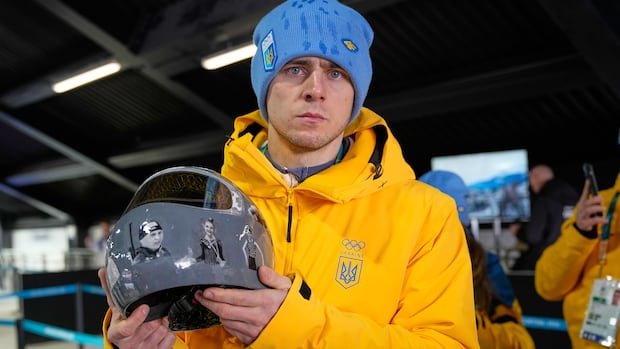
Determining what constitutes interference can be complex. Recently, the IOC barred Ukrainian athlete Vladyslav Heraskevych from competing for wearing a helmet adorned with images of war victims, which broke the rules. Despite the decision, IOC President Kirsty Coventry acknowledged the helmet’s powerful message. Heraskevych, a skeleton competitor, chose to defy the IOC’s directive not to wear the helmet, which depicted Ukrainian athletes killed by Russia, a country excluded from the Olympics following the 2022 invasion of Ukraine.
Although Heraskevych’s teammates protested the decision, Olympic historian Bruce Kidd noted that it aligns with a strict interpretation of the rules. Athletes are permitted to make political statements outside of competitions and ceremonies, such as through news conferences and social media. Some athletes have taken advantage of this allowance, including American competitors who criticized their country with anti-ICE messages.
Heraskevych argued that the rules were unfairly enforced against him, pointing to examples like Israeli skeleton athlete Jared Firestone, who wore a kippah bearing the names of Israeli athletes and coaches killed in the 1972 Munich Games but did so during the opening ceremony, not in competition. Moreover, the IOC instructed Haiti’s two-person team to remove an image of Toussaint Louverture, a key figure in the Haitian Revolution, from their opening ceremony jackets.
Enforcing these rules and defining political statements can be intricate and occasionally ambiguous, according to Kidd. The regulations trace back to the origins of the modern Olympics in the 1890s, where founder Baron Pierre de Coubertin intended the games to promote global peace and understanding, discouraging criticism of other nations’ politics. Despite this, athletes have historically challenged these boundaries, with instances like Irish track star Peter O’Connor raising an Irish flag at the 1906 Athens Games.
In a more recent example, at the 1968 Mexico City Summer Games, American sprinters Tommie Smith and John Carlos staged a “Black Power” salute on the podium, leading to their suspension from the U.S. team. Subsequent years have seen quieter political statements by athletes, with varying responses from officials. Kidd emphasizes that while statements unrelated to nation-state politics may be more tolerated, enforcing these rules has been inconsistent over time.
The overarching aim of the no-politics rule is to uphold liberal values and mutual respect, striving to prevent expressions of hatred or conflict that could incite aggression between states. Kidd acknowledges the complexity of governing sports in a global context filled with diverse perspectives and conflicts, emphasizing the challenge of promoting respect and understanding in a world marked by tension and xenophobia.