

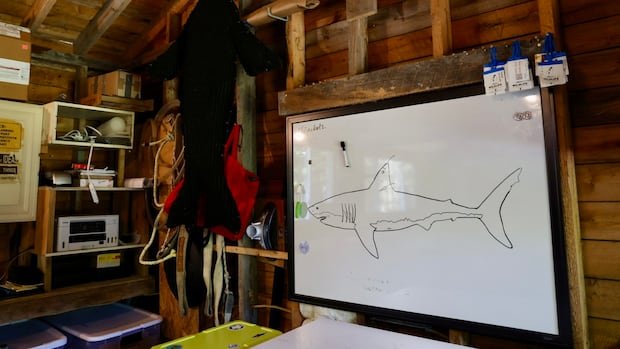

At a newly established research facility situated on an island off the South Shore of Nova Scotia, scientists are working to enhance understanding of white sharks in the region. Operating from the Tancook Islands Marine Field Station on Big Tancook Island, a team comprising both graduate and undergraduate students, under the guidance of Nigel Hussey, a professor at the University of Windsor in Ontario, employs various tracking technologies to monitor the movements of white sharks. During their inaugural year of operations, they successfully tagged 16 white sharks along the Nova Scotia coast. The upcoming 2026 tagging expedition is set to commence this weekend.
The field station has introduced its own tracking system, accessible to the public, enabling them to monitor the tagged sharks from 2025 and the ones to be tagged in 2026. However, the station’s founder highlighted challenges posed by Canada’s regulatory framework for studying these animals, emphasizing the need for streamlined processes to facilitate research activities.
Following Hussey’s participation in a tagging expedition conducted by Ocearch in Atlantic Canada in 2018, he, along with his wife Anna, established the Tancook Islands Marine Field Station. Initially skeptical about the abundance of white sharks in Atlantic Canadian waters due to historical rarity, Hussey’s perception changed, leading to the vision of a research hub in Nova Scotia dedicated to studying these creatures during their seasonal presence.
The primary research objectives of the field station include uncovering migration patterns, identifying congregation sites, estimating population size, and assessing the sharks’ ecological impact. Various tagging methods, including satellite tags, are being employed to achieve these goals, with recent advancements in satellite technology offering improved insights into white shark behavior. By the end of the summer, preliminary data is expected to identify key white shark locations in Atlantic Canada.
Despite the progress made, Hussey highlighted the complexities introduced by the current permitting system, particularly concerning the endangered status of white sharks, necessitating permits from Fisheries and Oceans Canada for scientific interaction with the species. Delays in permit issuance leading up to the 2026 expedition have highlighted logistical challenges, further compounded by generalized permit conditions that do not align with the sharks’ coastal habitat preferences.
Emphasizing the need for tailored permits to support diverse activities, including scientific research, commercial ventures, and documentary production, Hussey underscored the importance of long-term monitoring programs for comprehensive understanding of white sharks in the region. Fisheries and Oceans Canada spokesperson Christine Lyons stated that permit assessments are conducted on a case-by-case basis, with decisions typically reached within 90 days based on clear criteria and a precautionary approach.
Notwithstanding the permitting challenges, once operational, the field station is poised to nurture future scientists and benefit the local community. David Baker, a longstanding lobster fisherman and resident of Tancook, noted the positive impact of the research station on the community, providing opportunities for community engagement and economic growth. Plans to expand the station to include an educational center aim to promote public awareness and contribute to the island’s long-term development.