

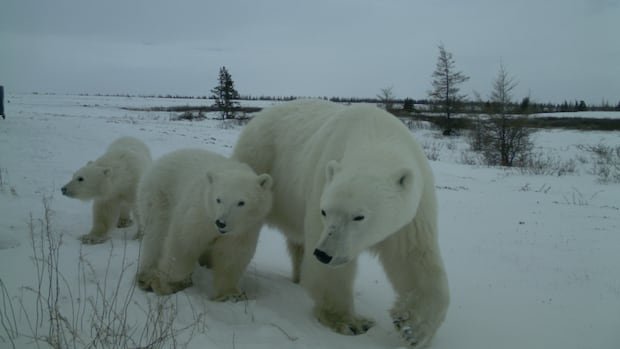

Inhabitants of Canada’s northern regions have observed a rise in polar bear sightings on land over the years, leading to encounters with humans. Previous assumptions suggested that these bears, possibly driven by hunger due to diminishing sea ice, were searching for food, including humans. However, an extensive 11-year study conducted by researchers from the University of Saskatchewan and University of Manitoba challenges this belief.
The study findings indicate that while the reduction in sea ice does play a role, it is not the primary factor as previously thought. Douglas Clark, a professor at the U of S, highlighted that contrary to expectations, it was not just emaciated bears appearing near communities. Instead, the duration spent off the ice influenced the likelihood of all bears, regardless of body condition, age, or sex, approaching human settlements.
Clark initiated bear monitoring 15 years ago by deploying trail cameras in Wapusk National Park near Churchill, Man. The research aimed to understand why polar bears were interacting more frequently with people. The study, recently published in Arctic Science, revealed that the bears’ behavior was driven by the shrinking sea ice, pushing them ashore for extended periods and closer to human activities.
Despite some bears facing hunger, they did not exhibit aggressive behavior towards humans. The study emphasized that the bears were not actively hunting people but were brought into proximity due to climate-induced changes. Researchers, including Alex Crawford from the U of M, stressed that although polar bears might seek food in desperate situations, they were not inherently predatory towards humans.
The ongoing research project aims to monitor polar bear behavior in response to long-term alterations in their environment and food sources. Understanding these dynamics is crucial for predicting future interactions between polar bears and humans in the changing Arctic landscape.