

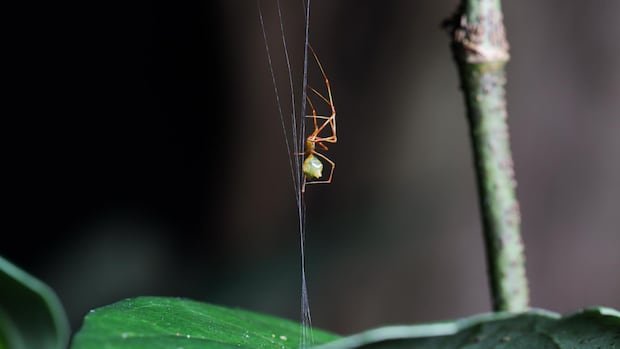

In a groundbreaking discovery, scientists have found a new spider species in the tropical rainforests of Australia that utilizes a unique hunting method. This spider employs a spring-loaded silk trap to launch its prey, such as green tree ants, into the air. The study, recently featured in the journal Current Biology, highlights this spider’s remarkable behavior, earning it the moniker “ballista spider” in reference to ancient Roman projectile weaponry.
Biologist Ajay Narendra from Macquarie University in Australia, one of the lead researchers, expressed awe at witnessing this behavior firsthand. The spider, part of the Propostira genus, is yet to be formally classified with a species name.
The initial observation of this phenomenon was made by researcher Greg Anderson in 2022, leading to a subsequent expedition to Queensland’s Cape York Peninsula in 2023 by a team from Macquarie University. Using high-speed cameras, the researchers captured the spider’s intricate hunting strategy, which involved setting up elaborate traps beneath their webs to ensnare green tree ants.
These nocturnal spiders, measuring between three to five millimeters in length, construct their traps during the night by attaching silk lines to anchor points before launching their prey into the air. The captured ants are then directed into the spider’s main web for consumption.
The researchers believe that the spider uses pheromones in its silk to attract green tree ants specifically, demonstrating a unique adaptation for targeted hunting. This evolutionary strategy allows the spider to capture formidable prey without direct confrontation.
Further analysis of the spider silk is planned to identify the specific pheromones involved in this specialized hunting technique. The study has sparked interest and curiosity among scientists like Saad Bhamla from the University of Colorado-Boulder, who suggests that the ants’ aggressive nature could play a role in their targeted capture by the spiders.
The ballista spider’s launch mechanism exerts significant force on the prey, far exceeding the G-force experienced by jet pilots during flights. This hunting tactic distinguishes the spider from the slingshot spider, another species with a similar approach, but with distinct differences in execution.
The ability of the ballista spider to store energy in its silk trap for launching prey showcases the marvels of nature, leaving researchers and enthusiasts alike fascinated by the ongoing discoveries in the natural world.