


Adriana Avelina Ruíz Márquez utilizes adhesive from false eyelashes to affix a miniature transmitter to the monarch butterfly’s thorax, positioned just behind its head. The monarch, weighing approximately half a gram, effortlessly carries the 60-milligram device, incorporating a solar panel comparable in size to a grain of rice.
After the intricate procedure, which necessitates a toothpick and a Q-Tip, the butterfly flutters its wings and promptly takes flight when released by Ruíz Márquez, who serves as the deputy director for the Monarch Butterfly Biosphere Reserve. This novel tracking device, a first in Mexico for tagging monarchs before their migration back north to the U.S. and southern Canada, is believed by Ruíz Márquez to aid in unraveling certain mysteries about the insects, utilizing individuals’ smartphones to monitor their movements.
The El Rosario butterfly sanctuary, situated in the mountainous region of Michoacán, about 180 kilometers west of Mexico City, serves as the overwintering site for the majority of North America’s monarchs east of the Rocky Mountains. A vital part of the Monarch Butterfly Biosphere Reserve, which spans Michoacán and the State of Mexico with a core protected area of roughly 135 square kilometers.
Teams from the federal Commission for National Natural Protected Areas and World Wildlife Fund (WWF) Mexico have tagged a total of 160 monarchs across the reserve, with 40 in El Rosario, using the new transmitters. This initiative, spearheaded by biologist Eduardo Rendón Salinas from WWF Mexico, aims to provide the most detailed insight into the butterflies’ initial migration leg northward.
The monarch’s migration journey spans up to 5,000 kilometers across three to four generations, with a remarkable super generation that completes the southward journey from late summer through the Prairies to the Maritimes and down to the U.S. Northeast and Midwest in one continuous flight. These monarchs mate in sanctuaries like El Rosario before commencing the northward journey again, laying eggs for the ensuing generation en route.
The microchipped transmitter emits a signal detectable by nearby iPhones, enabling crowd-sourced tracking of the butterflies’ trajectory for individuals utilizing the Project Monarch app or a handheld receiver. This innovation by New Jersey-based Cellular Tracking Technologies enhances the spatial detail significantly compared to previous tagging methods reliant on wing tags.
Following successful trials in 2023 and 2024, the transmitters were integrated into a continent-wide monarch tracking project, engaging over 20 groups. Launched in September 2025 in Ontario with the involvement of Environment and Climate Change Canada and Birds Canada, 30 monarchs were tagged at the Long Point, Ont., UNESCO biosphere reserve. The tracking data showcased the monarchs’ progression from Canada to Cuba and into Mexico’s Monarch Butterfly Biosphere Reserve by November.
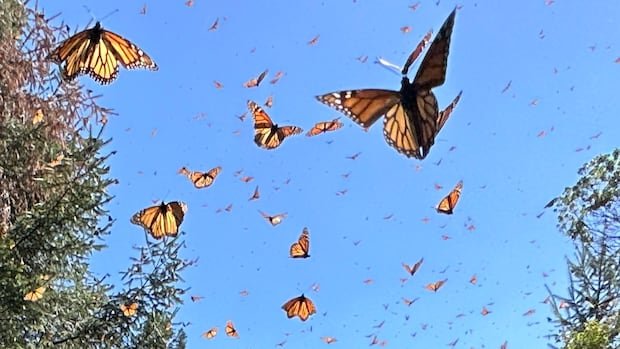
Between November and March, the reserve transforms into the realm of the monarchs, with the butterflies congregating and forming massive clusters on the oyamel branches. These clusters are so dense that branches occasionally buckle under their weight. The El Rosario community plays a crucial role in safeguarding the sanctuary from illegal activities like logging, ensuring the continued protection of the monarchs and their habitat.
The community of El Rosario has established a thriving tourism industry that operates during the monarchs’ winter stay, providing essential income to the locals. Additionally, they cultivate oyamel seedlings to sustain the forest’s health, underscoring their dedication to preserving this natural wonder that is the monarch butterfly.