

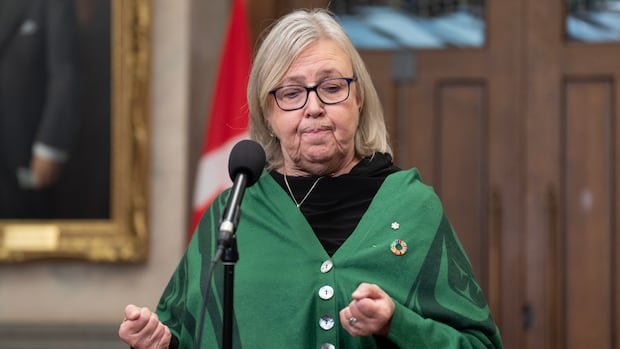

Green Party Leader Elizabeth May expressed her disappointment in supporting the Carney government during the budget vote, vowing not to repeat the error. May criticized the memorandum of understanding signed by Prime Minister Mark Carney and Alberta Premier Danielle Smith regarding energy policies, particularly the inclusion of federal tax credits for enhanced oil recovery. She described this move as a significant betrayal and a reversal, leading her to question the credibility of Carney’s promises.
May raised concerns about the government’s commitment to its word, emphasizing the prioritization of a deal with Smith over upholding previous assurances. The situation unfolded after cabinet minister Steven Guilbeault approached May to secure her vote for the budget, assuring her that tax credits for enhanced oil recovery would not be part of or added to the budget at a later stage.
Enhanced oil recovery involves a carbon capture process that injects carbon dioxide underground in oilfields to increase oil extraction while trapping the carbon dioxide underground. Environmentalists, including Guilbeault, view tax credits for this method as a direct subsidy to oil production. Initially, the budget excluded enhanced oil recovery from federal subsidies, but rumors of a potential reversal prompted May’s hesitance to support the budget until Guilbeault reassured her otherwise.
However, a subsequent agreement with Alberta, signed after May’s budget vote, committed Canada to extend federal tax credits to support large-scale carbon capture and storage projects, including enhanced oil recovery. This decision, among others, led to Guilbeault’s resignation from the cabinet.
May defended her budget vote based on securing Carney’s affirmation of Canada’s commitment to meeting the Paris Agreement climate targets. Despite her vote not being decisive, as both the NDP and Conservatives had two abstentions each, ensuring the budget’s passage and avoiding a winter election, May declared she would not repeat her mistake of supporting the government in the future.
Energy and Natural Resources Minister Tim Hodgson justified the inclusion of tax credits for enhanced oil recovery in the budget, citing its importance to Alberta’s interests. Hodgson emphasized the benefits of permanent carbon sequestration and the economic impact on Canadian steel industries, particularly in the context of using Canadian steel for drilling equipment.
Overall, the controversy surrounding the budget vote and the subsequent agreement with Alberta have sparked debates on environmental policies and government commitments.