

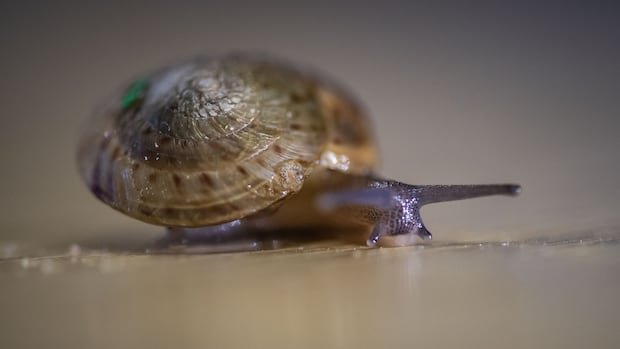

A decade ago, the only remaining population of greater Bermuda land snails was found in an alley in Hamilton, where they had settled on concrete slabs near a dripping air conditioner. Today, these native creatures are thriving in the wild again, all thanks to conservationists who bred them in captivity and released over 10,000 of them into Bermuda’s protected wooded areas in the past seven years.
Katie Kelton, an invertebrate keeper at Chester Zoo in the UK, shared in an interview that the snails are flourishing, with confirmed breeding and increasing numbers, marking the project as a success. The collaborative effort to save the species involved Chester Zoo, Canada’s Biolinx Environmental Research, and the Bermuda government. A study detailing the success of the program will be published in the upcoming issue of Oryx, The International Journal of Conservation.
Despite this progress, the snails still face threats from habitat loss and invasive predators, challenges that nearly led to their extinction. Greater Bermuda land snails, also known as P. bermudensis, may be small in size, but they play a crucial role in Bermuda’s ecosystems by decomposing leaf litter and providing calcium through their shells for native birds and reptiles.
Recognized as critically endangered by the International Union for Conservation of Nature (IUCN), these snails were pushed to the brink by human activities and the introduction of invasive predators. Their successful reintroduction was celebrated by the IUCN during Reverse The Red Day, which acknowledges efforts to combat biodiversity loss.
Katie Kelton expressed her delight in working with these endangered snails, emphasizing the team’s dedication to conservation. She highlighted the challenges faced in understanding the snails’ needs and creating optimal breeding conditions. While the rewilding efforts have shown success in some protected woodland sites, long-term survival remains uncertain, requiring ongoing vigilance against predators and habitat threats.
Timothy Pearce, a mollusk curator, stressed the importance of research like this in developing strategies for captive breeding and rewilding programs. The reintroduction of the snails to various sites in Bermuda has seen mixed results, with successes on offshore islands but challenges on the main island due to human activities and predators.
The conservation efforts on Nonsuch Island have been particularly fruitful, with the snails thriving in a carefully managed nature reserve. Despite the progress, continuous monitoring and conservation efforts are necessary to ensure the safety and sustainability of the reintroduced snail populations.
Katie Kelton expressed her gratitude for contributing to the rescue of these beloved snails, emphasizing the significance of giving this species a fighting chance against extinction.