


Welcome to our weekly newsletter focusing on environmental trends and solutions driving us towards a more sustainable world.
Hi, I’m Anand. I’m revisiting the topic of environmentally friendly burials after a reader mentioned concerns about medical implants. I explored two alternative practices to address this issue.
This week’s highlights:
1. Liquified, Composted: Evaluating the Sustainability of Alternative Burial Practices
2. The Big Picture: Standing Tall with Floating Solar Technology
3. Waste Pickers Advocate for Expanded Deposit Return Systems
For over two decades, Sam Sieber’s family has been involved in Aquamation, a process that uses water to decompose bodies rapidly without releasing carbon emissions into the atmosphere. Sieber, Chief Strategy Officer at Bio-Response Solutions, shared that families often choose Aquamation as an alternative to traditional cremation, driven by sentimental reasons such as a connection to water or a perception of gentleness in the process.
Aquamation, also known as alkaline hydrolysis, involves circulating water, heat, pressure, and alkaline chemicals within an industrial steel drum to break down the body efficiently, leaving only bones behind. Advocates claim this method consumes less energy, yields more solid remains, and produces no airborne emissions. Additionally, the process allows for the recovery of surgical devices and implants, promoting recycling and reuse.
Though the exact number of Aquamation procedures in Canada is unknown, the practice has been available in multiple provinces for over a decade, with Manitoba recently introducing it. The cost ranges from $1,000 to $2,000 per procedure. Notably, Archbishop Desmond Tutu opted for Aquamation in 2022 due to its environmental benefits.
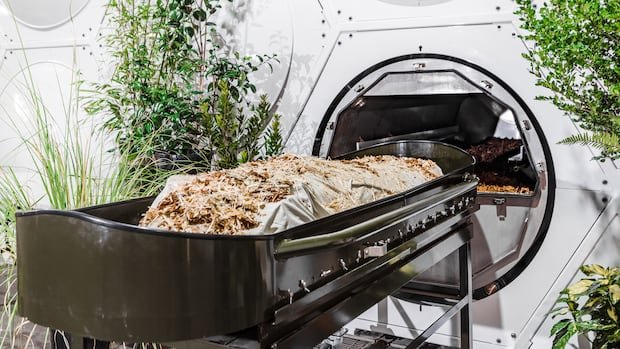
Another emerging environmentally conscious option is human composting, pioneered by Recompose. This process involves placing the body with plant materials into a vessel, resulting in soil production through heat and decomposition. Similar to Aquamation, human composting claims to be energy-efficient and environmentally friendly, offering a personal connection to the earth for the deceased.
Regarding the environmental impact of these alternative practices, Juliette O’Keeffe, a senior scientist, highlighted potential sewage and pathogen concerns associated with liquid remains and composted materials. While these methods are not widely adopted compared to traditional burial practices, they signify a growing trend towards sustainable end-of-life choices.
In conclusion, the shift towards eco-friendly burial practices reflects a broader movement towards environmentally conscious decision-making even after one’s passing.
– Anand Ram