

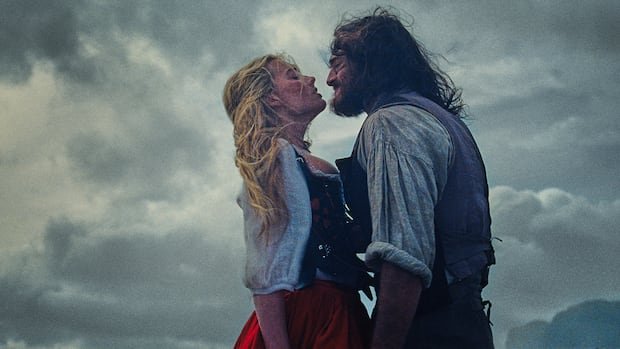

The word on director Emerald Fennell’s adaptation of “Wuthering Heights” is indeed true. Notably, the title of the movie notably includes quotation marks, a deliberate stylistic choice meant to be maintained when discussing it. Fennell’s take on Emily Brontë’s classic novel is a stylized reimagining based on her own nostalgic memory of reading the book as a young teenager. The film presents a visually striking, dreamlike portrayal of the ill-fated love story between brooding orphan Heathcliff (Jacob Elordi) and the ethereal Catherine (Margot Robbie).
However, the adaptation strays significantly from the original source material, lacking a clear intent to modernize the storyline. Critics argue that Fennell’s version often veers into provocative territory rather than staying true to the essence of “Wuthering Heights.” The movie opens with a controversial scene involving a public hanging, deviating sharply from the novel’s beginning. The casting of Elordi as Heathcliff has also sparked criticism, as the character’s racial background is a crucial element in the book that Fennell chooses to overlook.
Fennell’s adaptation focuses heavily on the passionate yet tumultuous relationship between Heathcliff and Catherine, overshadowing other important aspects of the narrative. This shift in emphasis alters the core themes of the story, reducing its depth and complexity. While creative liberties are not uncommon in adaptations, Fennell’s approach has been viewed as neglectful of the original message and themes of Brontë’s work.
By prioritizing a romanticized interpretation of the novel, Fennell transforms the characters and their motivations, leading to a departure from the source material’s darker and more nuanced portrayal. The film’s aesthetic, reminiscent of Tim Burton’s style, further distances it from the original setting and atmosphere of the story. Ultimately, Fennell’s “Wuthering Heights” adaptation, while intriguing in its reimagining, falls short of capturing the essence and depth of Brontë’s timeless classic.