

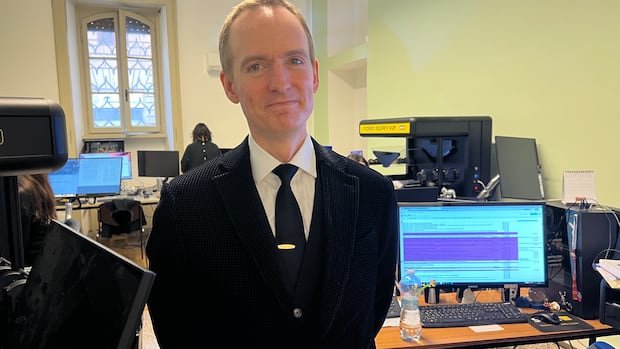

Matthew Harvey Sanders expressed his excitement when he discovered ChatGPT, seeing it as a solution to a lifelong problem. The 43-year-old Torontonian, dressed in formal black attire, was at the Pontifical Oriental Institute in Vatican City, surrounded by a vast library containing a rich collection of books on Eastern Catholic traditions.
Sanders, the CEO of Magisterium AI, is converting the extensive written records of the Catholic Church into an artificial intelligence platform. In a nearby office in Rome, a team of young women is scanning theological volumes using large scanners while robotic arms assist in turning the pages.
The platform focuses on Catholic teachings sourced from primary Catholic documents, ensuring accuracy and reliability. Sanders emphasizes the importance of not solely relying on AI for faith-related matters. While the Vatican has not officially endorsed the platform, Sanders received encouragement from Pope Leo XIV for his work in Catholic AI development.
Sanders, a former Anglican who converted to Catholicism, recognized a gap in accessing the church’s intellectual tradition and founded Magisterium to bridge this divide. The platform serves a global audience, with users ranging from clergy preparing sermons to lay Catholics seeking guidance on moral issues.
Magisterium aims to provide a reference tool rather than a replacement for traditional spiritual guidance. Sanders stresses the balance between utility and human connection to avoid users solely depending on AI for religious matters. The platform has garnered interest from a diverse user base, including individuals grappling with moral dilemmas and seeking clarity on Catholic teachings.
Sanders envisions Magisterium as a tool for fostering engagement with the church’s intellectual heritage and enhancing accountability within the Catholic community. The platform’s long-term goals include digitizing the Catholic Church’s statistical data to enable easier access to vital information for dioceses worldwide.