

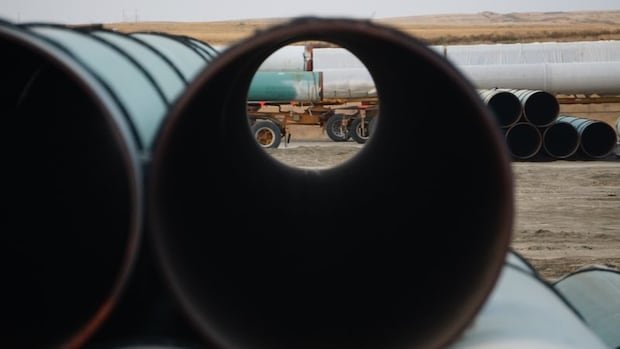

A plan put forth by South Bow, a Canadian company, aims to resurrect portions of the discontinued Keystone XL oil pipeline, potentially boosting Canada’s crude exports to the United States by over 12%. The success of this initiative hinges on approval from U.S. President Donald Trump and the construction of additional connections to American refining centers.
Unlike the previous Keystone XL project terminated by former U.S. President Joe Biden in 2021 amid opposition from Indigenous groups and environmentalists, the new proposal charts a different path through the U.S. South Bow, established by TC Energy in 2024 to take over its oil pipeline operations, is contemplating the revival of sections of the pipeline already constructed in Alberta and possessing all necessary Canadian permits.
Canadian Prime Minister Mark Carney broached the topic of reviving the pipeline during discussions with Trump in October. This move could offer leverage in forthcoming negotiations concerning the renewal of the Canada-U.S.-Mexico trade agreement (CUSMA).
Given Trump’s calls for lower oil prices and the reliance of many U.S. refiners on the approximately 4.4 million barrels of crude oil Canada exports southward daily, the proposal by South Bow has the potential to play a significant role. Bridger Pipeline, a potential U.S. partner for South Bow, has submitted a proposal to Montana regulators for the construction of a 1,038-kilometre pipeline capable of transporting up to 550,000 barrels per day from Phillips County, Montana, to Guernsey, Wyoming.
To reach refining centers like Cushing, Oklahoma, Patoka, Illinois, and the U.S. Gulf Coast, additional links would need to be established since Guernsey is not a primary market for crude oil. A suggested configuration involves a new pipeline spanning over 680 kilometres from Guernsey to Steele City, Nebraska, connecting to the existing Keystone mainline system, and subsequently linking to underutilized pipelines heading towards Cushing, Patoka, and Wood River, Illinois.
However, securing permits and navigating potential environmental litigation pose significant challenges for the Guernsey-to-Steele City segment of the project. South Bow has hinted at potential connections to downstream pipelines in the U.S., while Bridger Pipeline and the White House have chosen not to comment on the proposal.
Despite differing from the original Keystone XL project, the revival proposal is a large-scale pipeline expansion that could face opposition from environmentalists, landowners, and Indigenous communities. The potential project complexity and political risks spanning multiple administrations underscore the uncertainties surrounding its future.
Simultaneously, the Trans Mountain pipeline’s operator is planning capacity enhancements, while Enbridge has greenlit expansion projects for its Flanagan and Mainline pipeline systems. These developments, considered less intricate and more cost-effective than South Bow’s proposal, highlight the competitive landscape in the Canadian oil export sector.
Investors are likely to scrutinize South Bow’s financial capacity to undertake a new pipeline project while upholding dividends and managing debt levels.