

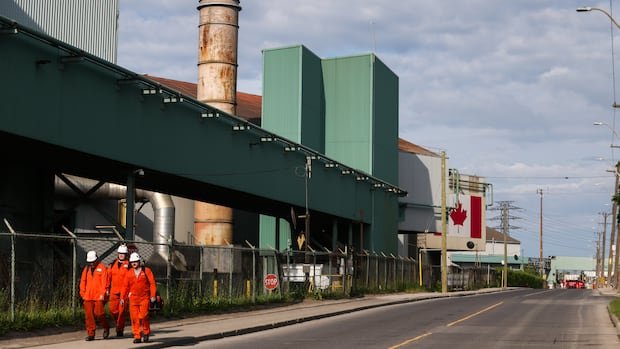

Prime Minister Mark Carney has unveiled a series of initiatives to support Canada’s steel and lumber industries, which have been negatively impacted by U.S. tariffs. The measures include financial aid and stricter controls on foreign products entering the Canadian market.
In a statement from Carney’s office, it was revealed that the Canadian government is cracking down on steel imports from countries with and without free trade agreements. For nations lacking such agreements, Canada is reducing the tariff rate quotas for steel products from 50% to 20% of 2024 levels. This move restricts the amount of steel that can be imported at lower duty rates.
During a press conference, Carney mentioned that these actions could potentially unlock over $850 million in domestic demand for Canadian steel. For countries with free trade agreements with Canada, excluding the United States and Mexico, their quotas for steel products will be reduced from 100% to 75% of 2024 levels.
The government also announced the discontinuation of temporary tariff exemptions on steel imports used in various sectors such as manufacturing, food and beverage packaging, and agriculture, effective January 31, 2026.
Additionally, the government is allocating $500 million to assist lumber companies facing financial constraints through the large enterprise tariff loan facility. Another $500 million will be provided to the Business Development Bank of Canada’s softwood lumber guarantee program, with a streamlined application process for support programs.
Furthermore, the federal government is urging railway companies to slash freight rates by 50% for transporting Canadian steel and lumber interprovincially, starting in the spring. This initiative will be funded by directing resources to Canadian National Railway and Canadian Pacific Kansas City, estimated to cost approximately $146 million for a year.
Derek Nighbor, president and CEO of the Forest Products Association of Canada, expressed optimism about the government’s announcement and stressed the importance of efficiently distributing the funding to address industry challenges.
The steel and aluminum sectors in Canada have faced significant challenges due to trade conflicts with the United States. President Donald Trump imposed tariffs on Canadian steel and aluminum, escalating them to 50% in June. Despite recent tensions and halted trade discussions with the U.S., Carney remains committed to finding resolutions to ongoing trade issues.
The content was sourced from: [link]