

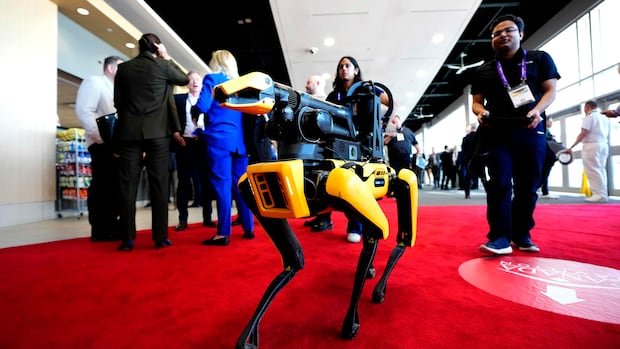

A worldwide competition is currently in progress to integrate robotics into our daily routines, with a new wave of AI-driven robots offering enhanced flexibility. The swift progress in artificial intelligence has led to robots being utilized for a variety of tasks, from collaborating with humans in warehouses to delivering packages on urban streets and inspecting hazardous sites.
Robots are now capable of learning on the job, a development that experts believe Canada could overlook if not embraced promptly. The prevailing buzzword in artificial intelligence is “physical AI,” prominently showcased at the recent Consumer Electronics Show (CES). The concept involves equipping physical systems, such as robots, autonomous vehicles, and industrial equipment, with sensors to enable them to function logically and responsively in the real world when combined with current AI approaches.
During CES, Google and Boston Dynamics, an American robotics company, disclosed their collaboration to trial AI-powered robots in Hyundai auto plants, specifically two models of a robot called Atlas. Although experts acknowledge that we are still far from having general-purpose humanoid robots that can perform household chores, such as dishwashing and laundry folding, AI is progressively transitioning into the physical realm.
Conventionally, robots are programmed in a top-down manner for specific sequences of actions, suitable for controlled environments with repetitive tasks like those in factory settings. However, adopting a bottom-up approach inspired by successful generative AI techniques allows robots to be trained in a more plug-and-play manner, enabling them to learn on the job.
This novel approach not only facilitates quicker adaptation by robots but also enables them to undertake more sophisticated tasks that involve reasoning and decision-making. Robots operating in dynamic environments, such as autonomous vehicles, can undergo training in virtual simulations to enhance their safety.
China is currently driving innovation and adoption in the robotics sector, asserting its position as a global leader. The country accounts for over half of the industrial robots installed worldwide, with a significant shift from importing to manufacturing robots, positioning China as a frontrunner in the industry.
On the contrary, Canada is perceived to be falling behind in robotics technology adoption, particularly in industrial settings. While the global robotics market witnessed substantial growth, Canada’s utilization of industrial robotics lagged in comparison to other nations. The country’s automotive sector demonstrates relatively higher adoption rates, but overall progress remains subdued, potentially linked to sluggish productivity growth.
Canadian companies encounter hurdles in marketing robotics domestically, often necessitating international sales for expansion. Despite Canada ranking fifth in service-robotics companies per capita, local companies struggle to flourish due to limited domestic market reach. Regulatory constraints in Canada are also cited as impediments to rapid adoption, contrasting with more innovation-friendly environments like the U.S.
Industry advocates, including the Canadian Robotics Council, advocate for a national robotics strategy in Canada to leverage the transformative potential of these technologies. While Canada is developing an AI strategy, it lacks a dedicated national robotics strategy akin to those in countries like China, South Korea, Germany, and Japan. The Canadian government, while not pursuing a standalone national robotics strategy, is focusing on broader AI strategies encompassing issues related to the development, commercialization, and adoption of AI technologies, including physical AI systems and automation.