

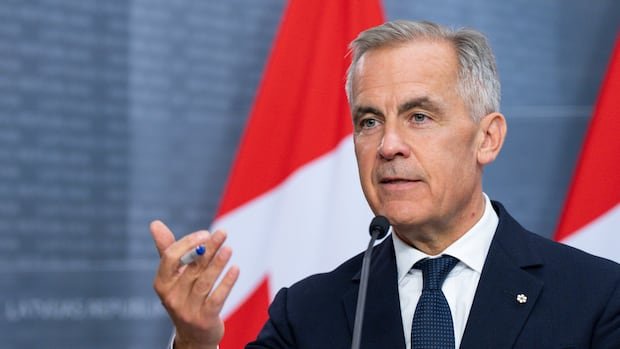

Prime Minister Mark Carney has declared that Canada will maintain its military presence in Latvia until 2029, as part of an effort to deter Russian aggression in Europe. This commitment has positioned Ottawa as a significant player in the transatlantic alliance.
During a news conference in Riga, alongside Latvian Prime Minister Evika Silina, Carney emphasized the importance of deterring and fortifying to provide genuine reassurance. Currently, there are 2,000 Canadian Armed Forces troops in Latvia under Operation Reassurance, which stands as Canada’s largest overseas mission.
Since 2017, Canadian troops have been stationed in Latvia to bolster Europe’s eastern defense and act as a deterrent against potential Russian incursions into Baltic countries. While the current mission authorization expires in March 2026, Carney has intentions to extend it for an additional three years.
Carney outlined plans to enhance the brigade’s capabilities in Latvia, reinforcing collective defense, strengthening cooperative security, and maintaining a robust NATO presence. Canada is collaborating with soldiers from approximately 10 countries in Latvia to bolster the nation’s defenses and provide training to Latvian military personnel, as highlighted by Carleton University professor Stephen Saideman.
The goal for Ottawa is to have a full contingent of 2,200 Canadian troops permanently deployed in Latvia by 2026. This objective has led to the construction of new infrastructure at the Adazi base near Riga to alleviate overcrowding. While the presence of 2,200 troops is occasionally achieved during specific exercises, efforts are ongoing to ensure a consistent deployment.
Carney’s visit is seen as an opportunity to educate Canadians about the significant commitment to Latvia and to showcase the increased defense spending, which comes at the expense of other domestic services. The complexity of the mission, led by Canada with contributions from various countries, requires meticulous coordination, as explained by Saideman.
Initiated in response to Russia’s 2014 actions in Ukraine, the mission has gained renewed significance following Moscow’s full-scale invasion of Ukraine in early 2022. Carney’s statements regarding Russian President Vladimir Putin’s reluctance to engage directly with Ukrainian President Volodymyr Zelenskyy in peace talks were made during his visit to Berlin earlier in the day.
Carney’s stance on Putin’s hesitancy was echoed by Marcus Kolga from the Macdonald-Laurier Institute, who praised Canada’s involvement in Latvia as a substantial international contribution. The mission is viewed as critical for safeguarding the region and showcasing Canada’s active role in global affairs.
Global Affairs Canada emphasizes the strong relationship between Canada and Latvia, rooted in shared values such as democracy, human rights, and adherence to the rules-based international order. Latvia, scarred by historical violence during Nazi and Soviet occupations, continues to benefit from Canada’s steadfast support and commitment to security in the region.