

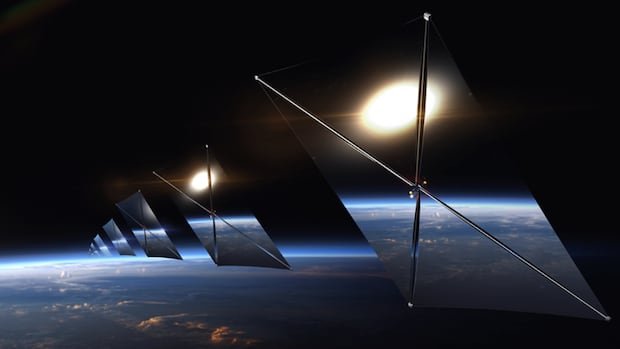

Despite facing opposition from the public in hundreds of comments, the U.S. Federal Communications Commission (FCC) has approved a project involving a massive space mirror that will reflect a beam of light back to Earth, spanning approximately five kilometers. Reflect Orbital, the company behind the space mirror, promotes the initiative as a means to provide “sunlight on demand” for various applications such as agriculture, solar energy, and emergency response.
While Reflect Orbital emphasizes the benefits of their proposal, concerns have been raised by astronomers and advocacy groups regarding potential hazards posed by the project. Issues include the impact on wildlife that rely on unpolluted night skies, interference with astronomical observations, and safety risks like flash-blinding individuals and causing eye damage to telescope users.
The FCC, responsible for regulating communication technologies, stated that these concerns fall outside its jurisdiction. Questions arise regarding who will oversee the use of a five-kilometer light beam and how it may affect communities and the environment. Reflect Orbital’s plan involves launching an extensive network of over 50,000 satellites by 2035, adding to the growing number of satellites orbiting Earth proposed by companies like SpaceX and Blue Origin.
Internationally, the United Nations Office for Outer Space Affairs (UNOOSA) administers space-related matters and international space law, with over 115 countries signatory to the 1967 Outer Space Treaty. While placing reflective objects in orbit is not explicitly prohibited, it is subject to careful consideration and consultation with other states to ensure peaceful space use. Experts suggest the need for regulations to address the potential impacts of projects like Reflect Orbital’s.
Reflect Orbital has expressed willingness to collaborate with authorities, scientists, and regulators to establish clear guidelines for responsible deployment. Meanwhile, discussions among UNOOSA, the International Astronomical Union, and other entities focus on safeguarding dark and quiet skies from satellite interference, aiming to mitigate the adverse effects of space-based illumination on astronomical research and the environment.
Efforts are underway to assess the effects of Reflect Orbital’s initial satellite and negotiate observation campaigns to evaluate its impact. The company’s ambitious plan to deploy thousands of mirrors raises concerns among astronomers and experts, emphasizing the need for proactive measures to preserve the integrity of astronomical observations and minimize disruptions to the night sky.