

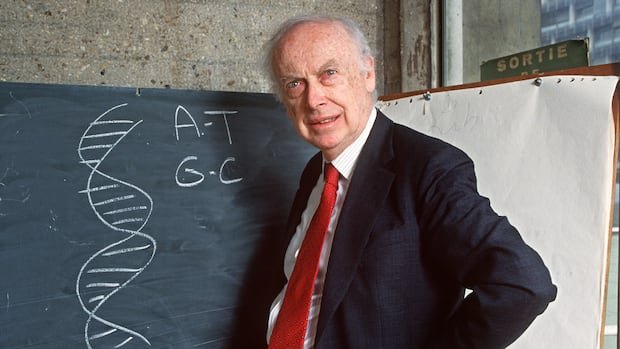

Renowned American biologist James D. Watson, known for his groundbreaking 1953 discovery of the structure of DNA, passed away at the age of 97, as confirmed by Cold Spring Harbor Laboratory in Long Island, where he was employed for an extended period. The New York Times reported his demise at a Long Island hospice.
Over the years, Watson’s legacy was overshadowed by controversial remarks on genetics and race, leading to his isolation from the scientific community. His earlier years were marked not only by scientific achievements but also by his provocative personality, which included utilizing another scientist’s data for personal advancement.
In his 1968 memoir, “The Double Helix,” Watson vividly recounted his collaboration with British physicist Francis Crick in deciphering the three-dimensional structure of DNA, a feat that earned them a share of the 1962 Nobel Prize in medicine and laid the groundwork for genetic engineering and gene therapy.
Despite their scientific success, criticism arose regarding Watson and Crick’s use of Rosalind Franklin’s research without proper acknowledgment. The ethical dilemma of ambition versus fairness in scientific pursuit was a central theme in Watson’s narrative.
In later years, Watson sparked controversy with racially insensitive remarks, resulting in his resignation as chancellor of Cold Spring Harbor Laboratory. Despite subsequent apologies, his reputation remained tainted by recurrent controversial statements.
Born in Chicago in 1928, Watson’s academic journey culminated in his pivotal role in elucidating the DNA double helix, a breakthrough that revolutionized genetics. His collaborative work with Crick laid the foundation for genetic information replication, paving the way for genetic engineering advancements.
Following the DNA discovery, Watson continued to make significant contributions to molecular biology, notably leading the initiative to decode the human genome in the U.S. His strategic emphasis on ethics in genetic research and his pivotal role in unveiling the human genome draft underscored his lasting impact on scientific progress.
Watson’s remarkable scientific journey was marked by both triumphs and controversies, shaping the landscape of genetics and molecular biology for generations to come.