

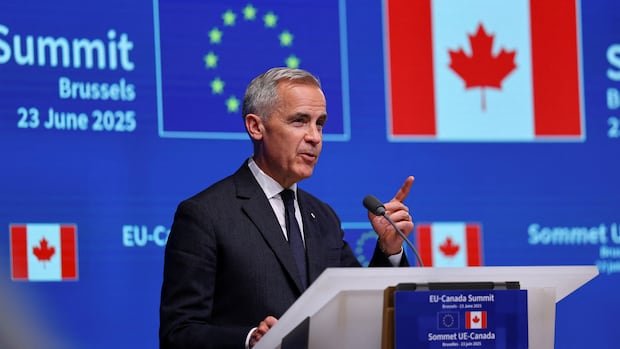

Canada has officially become a part of the European Union’s Security Action for Europe (SAFE) program, which amounts to €150 billion (equivalent to $244 billion Canadian dollars). The Defense Minister, David McGuinty, mentioned that the exact cost to the Canadian treasury is still undetermined.
This agreement signifies the first instance of a non-European country engaging in the joint military procurement initiative. According to McGuinty, Canada will have the opportunity to contribute resources like ammunition, missiles, drones, artillery systems, and infantry weapons. He emphasized the significant potential for private sector investments in Canada.
Negotiations for this partnership commenced after Prime Minister Mark Carney inked a defense-security agreement with the EU in June. The SAFE program enables partner nations to access low-interest loans for collaborative military equipment procurement. Moreover, Canadian firms can bid on these joint projects.
A European diplomat, speaking anonymously, revealed that countries joining the SAFE scheme are required to pay an entry fee. This fee is calculated based on various factors, including the anticipated business volume of Canadian defense contractors. It provides these companies with enhanced access to the loans, all guaranteed by the European Commission.
While an agreement has been reached, details such as financial commitments are still being finalized, as confirmed by McGuinty. An official from McGuinty’s office clarified that the fee will likely be in the millions, not billions, of dollars.
The United Kingdom has also been pursuing entry into the SAFE program, but recent discussions stalled due to a fee-related dispute. EU nations had set a deadline of November 30 for initial loan bids, with issuance expected next year. The impact of missing this deadline on Canadian companies seeking to participate remains uncertain.
The SAFE program, introduced by the EU in March, is part of Europe’s efforts to bolster defense capabilities amid the ongoing conflict between Russia and Ukraine. To date, 19 out of 27 EU countries have applied for loans under the program. Poland has been allocated the largest share, followed by Romania, Hungary, and France.
Leprecht highlighted the upcoming negotiations with the European Union Parliament for a multi-year fiscal framework, presenting new collaboration opportunities in defense procurement over the next cycle. The SAFE program has been identified as a crucial aspect of rebuilding Canada’s military and industrial sectors, as emphasized by Carney before signing the defense agreement.
Overall, this collaboration marks a significant step for Canada in entering the European defense arena and opens doors for substantial defense-related opportunities.