

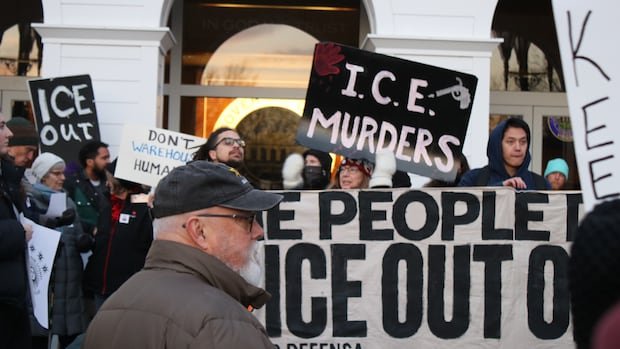

A massive warehouse near an outdoor gear store in Virginia has become a point of contention in light of the Trump administration’s immigration policies, drawing attention to a company from British Columbia. On Wednesday evening, a crowd gathered at the Hanover County Administration building in Virginia to express their opposition to the conversion of the warehouse into a facility for detaining immigrants by the U.S. Immigration and Customs Enforcement (ICE).
Hanover Board of Supervisors Chair Sean Davis stated the board’s disapproval of the property’s purchase by the U.S. Department of Homeland Security, which oversees ICE, from a Vancouver-based company, Jim Pattison Group. The Canadian firm clarified that it was unaware of the intended use of the warehouse when agreeing to sell it.
Although Jim Pattison Developments publicly listed the site for lease or sale and accepted an offer from a U.S. government contractor, it later learned about the property’s ultimate owner and purpose. The company emphasized its commitment to complying with all relevant laws regarding the sale.
The Department of Homeland Security plans to repurpose the 43.5-acre warehouse in Ashland, Virginia, as a “holding and processing” facility, which would include offices, cafeterias, and potentially additional structures like tents and a guard shack. Local officials expressed concerns about the suitability of the location for such a facility, given its initial development for commercial and residential purposes.
Despite limited authority over federal government projects like the ICE facility, the Hanover County board aims to communicate its opposition and potential impacts to the federal government. Legal options are also being explored by the county’s attorney. The controversy arises amidst heightened immigration enforcement in the U.S., following recent fatal incidents involving federal agents in Minneapolis.
Residents of Hanover County voiced contrasting opinions at the board meeting, reflecting the political divide in the community. Some supported ICE and President Trump’s deportation efforts, while others criticized the treatment of immigrants and protesters by federal authorities. Concerns were raised about safety, property values, and the potential impact of the facility on the neighborhood.
As debates continue, individuals like Harry Lee Hancock III expressed apprehensions about the facility’s implications, urging companies like Jim Pattison Developments to consider the consequences of their asset sales. The company acknowledged the sensitivity of the immigration enforcement issue and emphasized its respect for differing viewpoints.
Calls for ethical considerations in business dealings related to immigration enforcement have emerged, with stakeholders urging companies to uphold human rights standards. This situation underscores the complex intersection of immigration policies, business decisions, and community values, prompting discussions on corporate responsibility and societal impacts.