

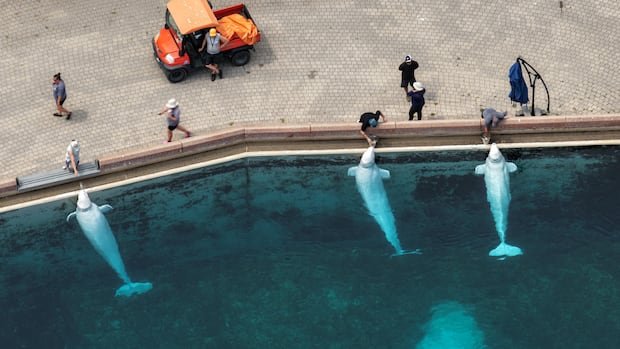

Earlier this month, the federal government greenlit a proposal that could see the 30 beluga whales currently residing at the closed Marineland facility in Niagara Falls, Ontario, embark on an international relocation to new habitats. Due to a 2019 Canadian law prohibiting the keeping of whales, dolphins, and porpoises for breeding or entertainment purposes, the belugas are anticipated to be distributed among an aquarium in Spain and four others in the United States.
The challenge now is how to transport these marine mammals, which can reach lengths of up to 4.5 meters and weigh up to 1,900 kilograms. While specific details from the destination aquariums coordinating the rescue operation are still pending, insights from experts familiar with the complexities of whale transportation shed light on the process.
Step 1: The paperwork and preparation
Belugas may not require passports, but obtaining permits from the Canadian government and the receiving countries is essential for their relocation, as explained by Andrew Trites, the director of the Marine Mammal Research Unit at the University of British Columbia. Decisions on each whale’s destination, based on their individual characteristics known to the trainers, will need to be made. Additionally, thorough health assessments, including veterinary examinations, bloodwork, and other checks, must be conducted before the belugas embark on their journey.
Although Ottawa has granted approval, further logistical arrangements and permits are still necessary before the whales can be transported, according to Johnny Ford, the vice president of communications at the potential recipient Shedd Aquarium.
Step 2: Practice, practice, practice
In preparation for the move, trainers typically spend months acclimating the belugas to the equipment used to transfer them from their enclosure, said Rob Lott, the captivity lead of the wildlife charity Whale and Dolphin Conservation based in Chippenham, UK. Familiarizing the belugas with a custom-made sling and stretcher involves encouraging them to explore and rewarding them for entering it, a process that can take several months depending on the individual whale’s temperament.
Step 3: Lifting belugas out of the tank
On the day of transportation, the belugas will be raised from their tank via slings and transferred into specially designed transport crates, where they will be supported on a stretcher. These crates must allow the animals to move their heads and tails comfortably and contain the appropriate amount of water for submersion without excessive sloshing. The crates are expected to be padded to minimize external noise that could distress the whales during the journey.
Step 3: Welcome aboard
The transport crates, with the belugas securely inside, will be transferred by truck to a cargo plane, accompanied by a team of trainers and veterinarians. Continuous monitoring of the animals’ breathing throughout the flight will ensure their well-being and comfort. Pilots may fly at lower altitudes to mimic the belugas’ natural environment, enhancing their safety and ease during the journey.
Step 4: Arriving at the destination
Upon arrival, the belugas will be lifted from the transport crates by sling and crane and transported to their new aquariums. Quarantine measures will be implemented to verify the animals’ health status and prevent the spread of diseases. Trainers familiar with the belugas’ behaviors will likely remain to pass on their knowledge to the new caretakers.
Why not release the belugas into the ocean?
Returning many belugas to their native waters, particularly those originating from Russia, poses geopolitical challenges, noted Lott. Releasing the Marineland belugas into the wild was deemed impractical and potentially harmful, according to Trites, as these animals, many of which were born in captivity, lack the essential skills to survive in the wild and integrate with wild beluga populations due to their social nature.