

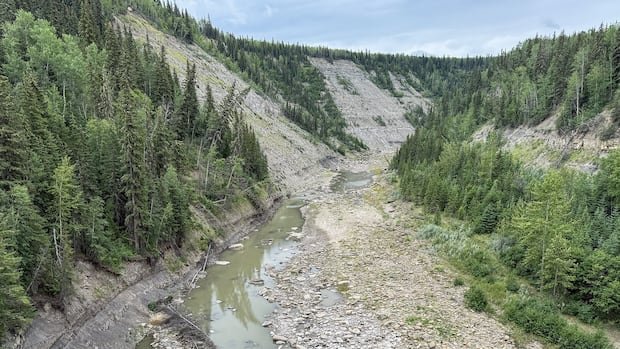

In the past five years, Haley Bassett has encountered recurrent water shortages on her family’s farm near Dawson Creek. The well often gets clogged with black sand, indicating the impact of a prolonged drought in the region. Bassett has observed various unusual changes on the property her grandparents started farming in the 1960s due to the prevailing dry conditions.
The northeastern part of British Columbia is currently facing severe or extreme drought, resulting in depleted rivers, strained reservoirs, and water usage restrictions imposed by local authorities. Bassett has noticed reduced crop yields, premature tree deaths, and a surge in weeds like Canada thistle. Additionally, winter winds blow more dust than snow at times, exacerbating the arid conditions.
Expressing concerns shared by advocacy groups, Bassett and others feel that the province undervalues its water resources, especially as it promotes the expansion of major projects such as mining, LNG, and AI data centers. Stand.earth and another environmental group have urged British Columbia to raise industrial water rates, citing the current rate of $2.25 per million liters as significantly lower than other provinces’ charges, which range from $54 to $179.
While the government asserts that every water license undergoes thorough review and control, critics argue that the province’s water management policies need to be more stringent, considering the worsening water scarcity issues. The Watershed Security Coalition claims that industrial water usage in B.C. is equivalent to the annual water consumption of 27 million people and emphasizes the importance of revising water rates to enhance watershed protection.
Bassett and others in the region remain skeptical about industry practices and government assurances. Bassett highlights the dire situation faced by neighboring communities like Dawson Creek, which has declared a state of emergency due to water shortages and advocates for swift action, such as the construction of a new water supply pipeline.
As climate change exacerbates water scarcity issues, experts like environment professor Joseph Shea stress the necessity of careful water management, especially with the increasing demands from new economic ventures. Raising industrial water rates could foster better water conservation practices and facilitate improved monitoring to safeguard water resources for future generations.
Despite governmental assurances, Bassett remains apprehensive about the region’s water future. She believes that urgent action is needed to address the growing water crisis and ensure that industry contributes fairly to water conservation efforts, particularly considering the strain on local communities.