

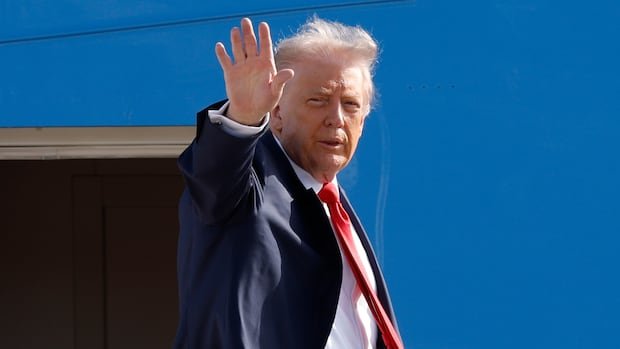

U.S. President Donald Trump announced on Saturday that he has instructed the Pentagon to start preparing for potential military intervention in Nigeria. Trump criticized the Nigerian government for not effectively addressing the persecution of Christians in the West African nation.
In a social media post, Trump stated, “If the Nigerian Government continues to allow the killing of Christians, the U.S.A. will immediately halt all aid to Nigeria and may consider military action to eradicate the Islamic Terrorists responsible for these atrocities.” He emphasized that any military action would be swift and forceful to protect Christians.
This warning of possible military involvement followed Nigerian President Bola Ahmed Tinubu’s response to Trump’s previous designation of Nigeria as “a country of particular concern” for failing to curb the persecution of Christians. Tinubu defended Nigeria’s commitment to religious freedom and tolerance, stating that the country upholds constitutional guarantees to protect citizens of all faiths.
Trump’s assertion that “Christianity is facing an existential threat in Nigeria” and that “radical Islamists are behind the mass killings” echoed recent calls by U.S. Sen. Ted Cruz to classify Nigeria as a violator of religious freedom due to reported incidents of “Christian mass murder.”
Nigeria, with a population of 220 million evenly split between Christians and Muslims, has grappled with security challenges from groups like Boko Haram, which targets both Muslims and Christians. While attacks in Nigeria have various motives, including religious, communal, and ethnic tensions, the majority of victims are Muslims in the Muslim-majority north.
Kimiebi Ebienfa, a spokesperson for Nigeria’s foreign affairs ministry, reaffirmed the government’s commitment to protecting all citizens regardless of their religion. Nigeria was previously listed as a country of particular concern for religious freedom violations but was removed from the list in 2023 to foster better relations between the U.S. and Nigeria.
Overall, the situation highlights the complex religious and security landscape in Nigeria, where the government faces challenges in balancing the protection of religious minorities while addressing broader security threats.