

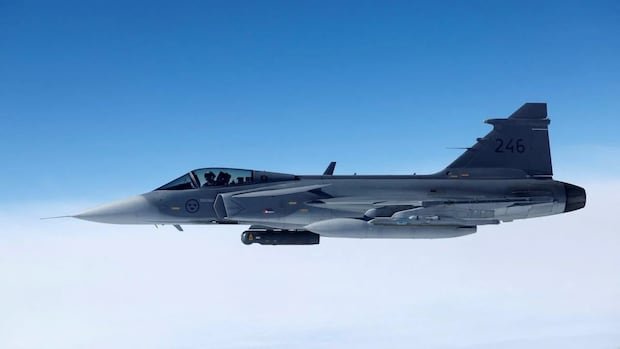

Saab, a Swedish aerospace company, has proposed to supply 72 Gripen fighter jets and six GlobalEye surveillance aircraft to the Canadian Armed Forces, aiming to generate 12,600 job opportunities in Canada. This proposal is currently under review by defense and economic experts in Ottawa.
Saab had previously indicated the potential creation of 10,000 jobs in Canada, but the specific aircraft quantities needed to reach this target were unspecified. The Canadian government is keen on diversifying its military equipment sources and revitalizing the industrial sector, which has faced challenges due to tariffs imposed by former U.S. President Donald Trump.
Industry Minister Mélanie Joly emphasized the government’s interest in projects that bolster national security while fostering job growth. Saab reiterated its commitment to supporting Canada with advanced solutions for its Armed Forces, emphasizing the job-creation aspect of the Gripen and GlobalEye aircraft sales.
The procurement of a Gripen fleet would impact Canada’s plan to purchase 88 F-35 aircraft from the U.S., a deal valued at over $27 billion. While discussions on potential adjustments to the F-35 order are ongoing, concerns have been raised about integrating two distinct fighter jet fleets simultaneously.
Saab plans to establish production facilities in Ontario and Quebec, collaborating with Bombardier for GlobalEye aircraft production. The company aims to create over 10,000 jobs in Canada through a network of suppliers across the country. Additionally, Saab has attracted interest from Ukraine for Gripens and from countries like France and Germany for GlobalEye aircraft.
Canada’s defense spending is projected to rise by $82 billion over the next five years, with a focus on maximizing economic benefits. The appointment of Christiane Fox as the new deputy minister at the Department of National Defence signals the government’s intent to bring fresh perspectives to military decision-making.
Despite the job creation potential, some experts caution against basing aircraft acquisition solely on economic considerations. Questions remain about integrating Gripens into existing defense systems and the feasibility of managing multiple fighter jet fleets concurrently, highlighting the need for a balanced approach between military requirements and economic benefits.
Public opinion on fighter jet options varies across regions and political affiliations, with preferences influenced by factors such as perceived military capabilities and international alliances. The ongoing debate between the Gripen and F-35 reflects Canada’s evolving defense priorities amid changing geopolitical dynamics.
The decision-making process will involve careful evaluation of technical capabilities, costs, and economic impacts. The F-35 emerged as the preferred choice in a previous competition based on these criteria, underscoring the complex considerations involved in procuring advanced military aircraft.