

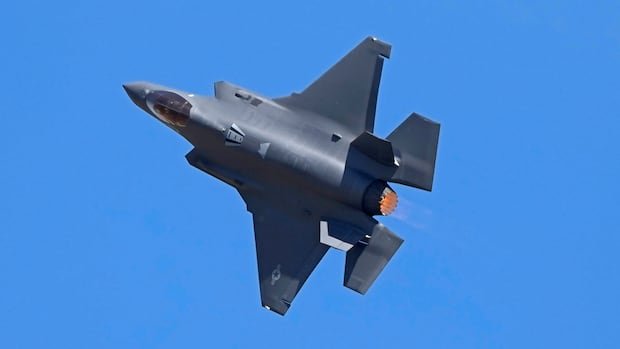

Former high-ranking officials of the Canadian Armed Forces are defending the proposed purchase of 88 American F-35 fighter jets, aiming to halt the ongoing talks between the Canadian government and Swedish company Saab. A group of twelve ex-officers of the Royal Canadian Air Force has penned a letter to the federal government emphasizing the advantages of procuring a full fleet of F-35s to meet Canada’s defense requirements. The signatories are advocating against reducing the F-35 order and substituting it with Gripen-E fighter jets from Saab, which pledges substantial job creation in Canada.
The letter, not yet public, was dispatched to key government decision-makers related to the fighter jet issue, including the office of Prime Minister Mark Carney. Carney initiated a review of the acquisition of F-35s from American manufacturer Lockheed Martin earlier this year in response to security concerns raised by U.S. President Donald Trump. While Canada is in the process of acquiring a minimum of 16 F-35 aircraft, there is no commitment yet to fulfill the complete order of 88 jets placed in 2023.
Among the letter’s signatories is Tom Lawson, the former chief of the defense staff of the Canadian Armed Forces from 2012 to 2015. Lawson, in an interview with CBC News, expressed reservations about purchasing Gripen fighter jets, emphasizing the unmatched quality and capabilities of the F-35. He cautioned that opting for a secondary fleet would compromise Canada’s defense preparedness in wartime scenarios. Lawson highlighted the F-35’s superior stealth features, radar evasion capabilities, and data integration abilities for airspace surveillance.
Acknowledging the Canadian government’s interest in diversifying military equipment sources beyond the U.S., Lawson underscored that reducing the F-35 purchase was not the right approach to convey this message. While he previously served as a consultant for Lockheed Martin, Lawson affirmed that his stance on the matter remained consistent with his tenure in the Canadian Armed Forces and NORAD.
The potential acquisition of Gripen-E fighters has been a subject of discussion, with Saab offering economic incentives and job opportunities in Canada. Minister Mélanie Joly has stressed the need for increased industrial benefits from Lockheed Martin concerning the F-35 contract. The decision on the fighter jets’ purchase is crucial as it could impact thousands of jobs, particularly in the maintenance sector.
The Mirabel site, where maintenance of CF-18 fighter jets currently takes place, could face job losses if Canada opts for a mixed fleet of F-35s, according to L3Harris MAS officials. A partnership with the U.S. armed forces is deemed essential for the site’s economic viability. The potential acquisition of electronic surveillance aircraft is also under consideration, with Saab, Bombardier, and Boeing competing for the contract. The economic spin-offs and technological capabilities of these aircraft are key considerations for Canada’s defense procurement decisions.