

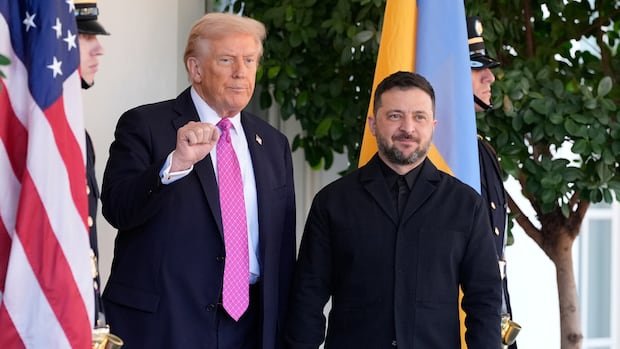

Ukrainian President Volodymyr Zelenskyy expressed to Axios on Friday his willingness to present a potential peace framework reached with U.S. President Donald Trump to a referendum if finalized during their upcoming meeting in Florida this weekend. The primary focus of their discussions will be on reaching an agreement to end the ongoing Ukraine-Russia conflict.
Zelenskyy mentioned that the proposed 20-point plan, which is nearly 90% complete, will be a key topic of conversation during the meeting. Additionally, discussions will encompass security assurances for Ukraine and the possibility of an economic agreement, although Zelenskyy indicated uncertainty about finalizing any deals by the end of the meeting at Mar-a-Lago, Trump’s residence in Palm Beach, Fla.
The Ukrainian President also noted that territorial issues will be raised during the talks and expressed a desire for European involvement in the peace process, though he acknowledged the challenges of coordinating such involvement on short notice.
Furthermore, Zelenskyy shared details of a positive call with Prime Minister Mark Carney, updating him on the diplomatic progress with the U.S. Zelenskyy emphasized the importance of broader representation in future negotiations involving Ukraine, the U.S., and European stakeholders.
The meeting between Zelenskyy and Trump represents a significant step in the ongoing diplomatic efforts to resolve the conflict that has persisted for nearly four years. While progress has been made, challenges remain as Moscow and Kyiv present conflicting demands in the negotiations.
Recent engagements between Zelenskyy and key U.S. representatives, including special envoy Steve Witkoff and Jared Kushner, suggest ongoing dialogue and potential pathways for further negotiation. The Kremlin’s interaction with U.S. envoys signals a continued dialogue aimed at finding common ground to facilitate peace talks.
Zelenskyy’s proposed peace plan includes the establishment of a demilitarized zone in Ukraine’s eastern region, contingent on reciprocal actions by Russia and international monitoring. However, Russia’s stance on territorial control in the Donbas region remains a significant point of contention, with Moscow demanding the relinquishment of Ukrainian-held territories.
Violence continues to impact civilian populations, with recent incidents in Kharkiv and Zaporizhzhia resulting in casualties. Ukraine’s retaliatory strikes on Russian oil refineries indicate a strategic shift in disrupting Russia’s resources, while Russia’s attacks on Ukrainian cities aim to undermine vital infrastructure and escalate the humanitarian crisis.
The evolving dynamics of the conflict underscore the urgent need for diplomatic resolutions and sustained international engagement to secure lasting peace in the region.