

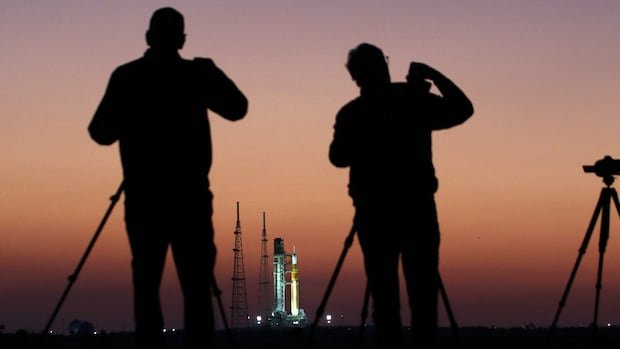

Artemis II is gearing up for its upcoming journey around the moon and back, marking a significant milestone in human space exploration. The mission will involve four crew members, including Canadian Space Agency astronaut Jeremy Hansen and NASA astronauts Reid Wiseman, Victor Glover, and Christina Koch, who will be traveling aboard the Space Launch System (SLS) rocket and inside the Orion spacecraft. The launch is scheduled to take place from Launch Pad 39B at Kennedy Space Center in Florida.
The mission has faced delays in the past due to hydrogen and helium issues, as well as weather considerations. However, NASA has indicated that the current launch window on April 1 has an 80% chance of proceeding as planned. The launch is set for Wednesday, April 1, from 6:24 p.m. to 8:24 p.m. ET, with subsequent opportunities available from Thursday, April 2, to Monday, April 6, in case of a scrubbed launch.
To witness the Artemis II launch in person, individuals can contact ask@cbc.ca for more information. Detailed information on the countdown to liftoff is available on NASA’s website.
CBC News will provide comprehensive coverage of the mission, with reporters stationed at Kennedy Space Center to deliver updates across various platforms. Live coverage will begin two hours before the launch on CBCNews.ca, including a livestream of the event. Viewers can also tune in to special broadcasts on CBC News Network, CBC Radio, and online platforms.
Artemis II’s trajectory will involve a journey around the moon without a landing, serving as a crucial test for systems with astronauts on board. The Artemis missions are part of NASA’s ongoing efforts to establish a sustained presence on the moon for scientific research and economic activities, with the ultimate goal of paving the way for future missions to Mars.
NASA’s accelerated plans for lunar exploration aim to regain leadership in space exploration and keep pace with other countries, such as China, which is also making strides in lunar ambitions. The Artemis II mission is a pivotal step in this journey, lasting approximately 10 days before the crew splashes back down in the Pacific Ocean.