

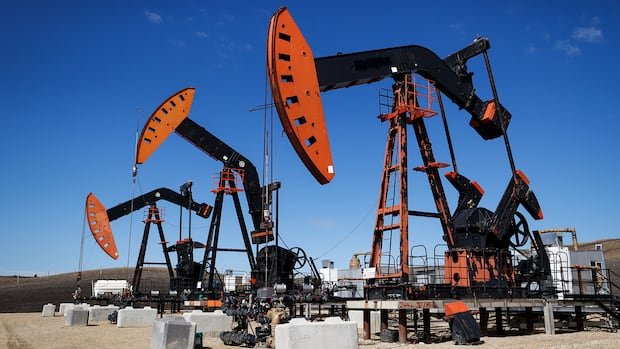

Oil prices experienced a decline on Monday morning following President Donald Trump’s announcement that the United States would delay any action on targeting Iran’s energy infrastructure amid positive discussions between the two nations. West Texas Intermediate, the North American benchmark, was trading below $90 US, marking a decrease of more than nine percent, while stock markets saw a surge at the opening of trading.
At the close of the markets, the S&P 500 had climbed by 74.52 points to reach 6,581.00. The Dow increased by 631.00 points, or 1.4 percent, to 46,208.47, with the Nasdaq composite rising by 299.15 points, or 1.4 percent, to 21,946.76. The S&P/TSX composite index also showed growth, up by 566.40 points at 31,883.81.
President Trump disclosed that he would postpone any strikes on Iranian power facilities for five days, highlighting the progress made in discussions aiming at resolving hostilities in the Middle East. The ongoing conflict in the region has led to a nearly 50 percent surge in oil prices this month.
Contrasting his earlier statements, Trump’s recent announcement took a more conciliatory tone, in stark contrast to his weekend threats of escalating tensions. He had warned on Truth Social that failure by Iran to allow free passage through the Strait of Hormuz within 48 hours would result in the U.S. military targeting Iranian power plants.
In response, the Islamic Revolutionary Guard Corps, as reported by Iranian media, vowed to completely shut down the Strait of Hormuz if the U.S. proceeded with attacks on Iranian energy infrastructure. Trump has outlined military objectives for a potential conflict with Iran, which include neutralizing Iran’s military capabilities, defense infrastructure, and nuclear program, while also safeguarding U.S. allies in the region.
The energy markets have been heavily impacted by the conflict, with Iran’s control over the vital Strait of Hormuz leading to a significant increase in energy prices. Analysts are speculating that if the disruptions in Gulf exports persist, oil prices could potentially reach $200 a barrel in 2026. Experts predict that even after the conflict ends, it will take several months for the energy markets to stabilize.
Kurt Barrow, an analyst at S&P Global specializing in oil and fuels, emphasized the challenges ahead, noting that the energy crisis is shifting towards a demand and availability issue. With a shortfall of around 15 million barrels per day in various fuel types, including crude oil, jet fuel, and diesel, the industry faces significant supply chain disruptions.
The uncertainty in the North American oil industry has created a cautious atmosphere, with concerns about the potential consequences of prolonged high oil prices on global demand. The industry is bracing for challenges, with Kevin Krausert, CEO of Avatar Innovations and a former Alberta drilling executive, highlighting the seriousness of the current situation and the need for responsible decision-making in the face of rising oil prices.
As the conflict with Iran enters its fourth week, Trump’s social media post regarding potential strikes adds to the ongoing tensions in the region.