

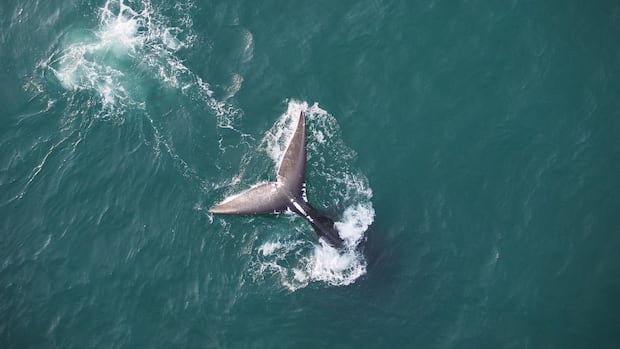

The United States is considering revising regulations aimed at preventing ships from colliding with the critically endangered North Atlantic right whale off the East Coast. The National Oceanic and Atmospheric Administration (NOAA) of the country has highlighted the potential for modern technology to avert collisions between ocean vessels and whales while still meeting industry requirements.
NOAA’s administrator, Neil Jacobs, mentioned in a news release on March 4 that the proposed action aligns with the President’s agenda of embracing advanced technologies, supporting American industries, and streamlining efficient regulations. The agency is open to external suggestions on how to mitigate the “unnecessary regulatory and economic burdens” linked to the speed restrictions imposed on larger vessels in 2008.
Despite the optimism around technology, experts caution that current advancements are not sufficient to prevent whale collisions effectively. Sean Brillant, from the Canadian Wildlife Federation, emphasized that while various technologies like satellites, thermal imaging, and aerial surveys aid in whale detection, they fall short in predicting the animals’ travel directions.
Moira Brown, the science director at the Canadian Whale Institute, noted that infrared cameras on ships can spot whales at a distance but are still undergoing experimental phases. Brown stressed the importance of combining new technologies with existing speed regulations to enhance whale protection, labeling any changes to speed limits as a setback for conservation efforts.
NOAA’s 2020 report assessed the impact of speed limit regulations, which mandate larger ships to slow down at specific locations and times. The report indicated a decrease in whale fatalities post-implementation but recommended stronger enforcement, wider application to smaller vessels, and adjustments to speed limit timings and areas for further improvement.
Captain Bob Peacock, a veteran ship pilot in Maine, emphasized the significance of adhering to speed limits and effective communication in preventing whale collisions. He expressed commitment to maintaining the 10-knot speed limit even if NOAA alters regulations. While acknowledging the potential of drones in whale detection, Peacock stressed the importance of human observation and collaboration in safely navigating whale habitats.
Fisheries and Oceans Canada reported four documented North Atlantic right whale deaths in 2017 attributed to ship collisions. The declining whale population since 2010, with major causes of death being entanglement in fishing gear and vessel strikes, raises concerns. The North Atlantic right whale population is estimated to be less than 400, underscoring the urgency of conservation efforts.