

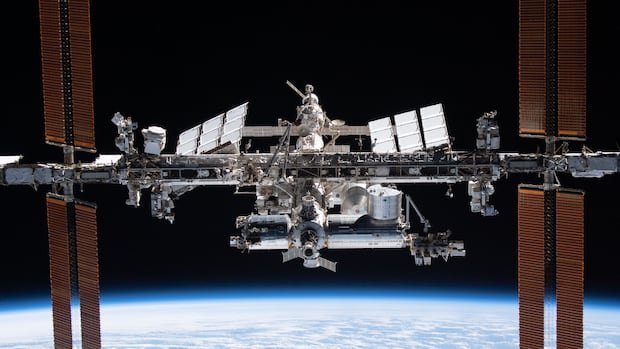

Historical structures such as Alexander Graham Bell’s residence in Nova Scotia are often transformed into museums or national historic landmarks to safeguard their legacy for future generations. But how do you protect a building the size of a football field that orbits 400 kilometers above Earth?
NASA’s official strategy is to intentionally deorbit the International Space Station (ISS) at the end of its operational life, leading to a controlled reentry into Earth’s atmosphere and a crash landing in a remote ocean area. However, recent legislative actions by certain U.S. Government members urge NASA to reconsider this plan and explore the possibility of maintaining the ISS in low Earth orbit.
Since the year 2000, the ISS has accommodated numerous astronauts from the U.S., Russia, Canada, Europe, and Japan, hosting a wide array of experiments in a unique microgravity environment. Assembled through multiple space shuttle and rocket launches, the ISS, with a mass exceeding 400 metric tonnes, stands as the largest scientific laboratory ever deployed in space.
Despite its remarkable history, the ISS is approaching the end of its operational lifespan. NASA has disclosed plans to decommission the space station by 2030 and initiate its deorbit in 2031, employing a SpaceX rocket to guide its controlled reentry into Earth’s atmosphere for eventual disintegration over the Pacific Ocean, akin to the fate of the previous Russian Space Station MIR.
U.S. Rep. George Whitesides, a former NASA chief of staff, recently proposed an examination of alternative options before committing the ISS to a fiery demise, emphasizing the importance of exploring potential avenues for preserving this engineering marvel for future generations. However, challenges such as the ISS’s continuous orbital decay and the risks associated with boosting it to higher orbits pose significant hurdles to sustaining the station’s existence.
While some have suggested boosting the ISS to a higher orbit or seeking private sector interest in its utilization, the complexity, high maintenance demands, and potential risks involved in such endeavors present substantial obstacles. With NASA’s current focus on lunar and Martian exploration, the fate of the ISS remains uncertain, raising questions about the feasibility and practicality of preserving it as a historical artifact.
Despite ongoing discussions and proposals for alternative uses of the ISS, the likelihood of its eventual deorbit and destruction looms large, symbolizing the culmination of a remarkable era in space exploration unless groundbreaking solutions emerge to alter its course.