

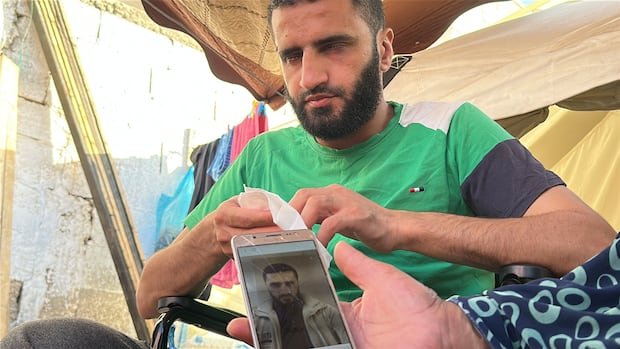

Mahmoud Abu Foul has returned to Gaza after spending more than nine months in Israeli detention. As he arrived home, surrounded by well-wishers welcoming the released detainees, he couldn’t locate his family due to his loss of eyesight during his imprisonment.
The 28-year-old Palestinian, who previously lost his left leg in a 2015 Israeli airstrike, recounted enduring multiple beatings and torture at an infamous Israeli military prison, resulting in his blindness. Speaking from a tent in Nuseirat refugee camp in central Gaza, where he now resides with his mother, Abu Foul expressed his desire to regain even partial eyesight upon leaving prison.
Abu Foul was arrested by the Israel Defence Forces on December 27, 2024, at Kamal Adwan Hospital in northern Gaza while undergoing treatment for his amputated leg sustained in an airstrike a decade earlier. Following the raid on the hospital, where several staff members were detained, including hospital director Dr. Hussam Abu Safiya, who remains in custody.
Upon his release on October 13, Abu Foul was among over 1,700 Palestinian detainees liberated by Israel under a ceasefire agreement with Hamas. Despite his return to Gaza, Abu Foul lamented not being able to see the familiar sights due to his blindness, which overshadowed the joy of being back home.
His mother, Umm Ahed Abu Foul, found him at Nasser Hospital in Khan Younis hours after the detainees returned, shocked to discover her son’s loss of eyesight. She shared her deep emotional pain, reflecting on a past photo of her son beaming with happiness, now contrasted with the reality of his condition.
Abu Foul detailed his ordeal in Israeli detention, alleging false terrorism accusations and regular mistreatment by guards, particularly at Sde Teiman in southern Israel. The conditions at the barracks, where he was held, were described as torturous, with severe beatings and psychological abuse inflicted on detainees.
Despite previously losing a leg and enduring displacement due to past conflicts, Abu Foul highlighted the profound impact of losing his vision as the most challenging experience. He expressed a deep yearning to witness his surroundings, including the devastation caused by conflicts, emphasizing the anguish of solely hearing his family’s voices without the ability to see them.
Abu Foul recounted instances of severe physical abuse, including being rendered unconscious after a guard’s assault, leading to his blindness. He emphasized the lack of adequate medical care for his vision-related issues during his imprisonment, further exacerbating his condition.
The Israeli military, responsible for the detention facilities, has refuted claims of systematic abuse, reiterating compliance with legal standards and investigative measures. In a report by B’Tselem, systematic mistreatment and torture of Palestinian detainees by Israel were documented since the outset of the Gaza conflict, with reports of severe human rights violations.
Addameer, a Palestinian prisoner rights group, highlighted the plight of Palestinian detainees under Israel’s Unlawful Combatants Law, denouncing it as a form of administrative detention. The United Nations has condemned Israel for systematic torture and ill-treatment of Palestinian prisoners, urging immediate action to uphold human rights standards.
For Abu Foul, his ultimate wish is to access medical treatment abroad that could potentially restore his eyesight, offering hope for a better future despite the traumas he endured in Israeli detention.