

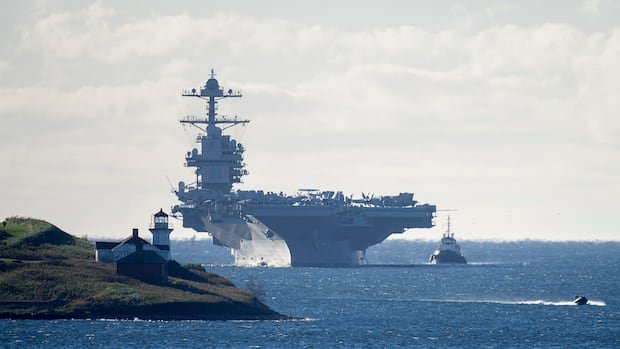

The Pentagon announced on Friday that a U.S. aircraft carrier is being deployed to the waters off South America as part of an escalation of military activities in a region where the Trump administration has been conducting rapid strikes against suspected drug-carrying vessels.
Defense Secretary Pete Hegseth has directed the USS Gerald R. Ford and its accompanying strike group to move to the U.S. Southern Command area to enhance the United States’ ability to identify, monitor, and disrupt illicit actors and activities that threaten the safety and prosperity of the country, according to Pentagon spokesperson Sean Parnell.
The USS Ford, which includes five destroyers in its strike group, is currently stationed in the Mediterranean Sea. As of now, one destroyer is in the Arabian Sea, another in the Red Sea, and the aircraft carrier itself is docked in Croatia on the Adriatic Sea.
There are approximately 6,000 sailors and Marines aboard eight warships in the region, with the potential arrival of the USS Ford strike group anticipated to bring around 4,500 additional sailors and nine squadrons of aircraft assigned to the carrier.
The recent deployment of an aircraft carrier and the increased pace of U.S. strikes, including a strike on Friday, have sparked speculation about the extent of the Trump administration’s operations against drug trafficking and whether there might be intentions to remove Venezuelan President Nicolas Maduro, who is facing narcoterrorism charges in the U.S.
Tropical Storm Melissa, currently lingering in the central Caribbean and possibly strengthening into a hurricane, adds an additional complication to the situation.
In the midst of these developments, Defense Secretary Hegseth revealed that the military had carried out the 10th strike on a suspected drug-running vessel, resulting in the deaths of six individuals. The total death toll from the attacks, initiated in early September, now stands at least 43.
Hegseth emphasized that the vessel targeted was linked to the Tren de Aragua gang, marking the second time the Trump administration has associated its operations with this gang originating from a Venezuelan prison.
The U.S. military has intensified its strikes, with three conducted this week alone, expanding into the eastern Pacific Ocean where a significant portion of cocaine smuggling occurs from major producers like Colombia.
Furthermore, the Trump administration imposed sanctions on Colombian President Gustavo Petro and his associates on Friday over alleged involvement in the global drug trade, heightening tensions with Colombia.
Maduro of Venezuela has accused the U.S. of attempting to oust him from power, as evidenced by his praise for security forces and civilian militia’s defense preparations along the country’s coastline in anticipation of a potential U.S. attack.
The presence of the U.S. military in the region is seen by some analysts, like Elizabeth Dickinson of the International Crisis Group, as a means to assert U.S. influence in the region beyond drug-related issues, signaling a broader message to countries aligning with U.S. interests.