

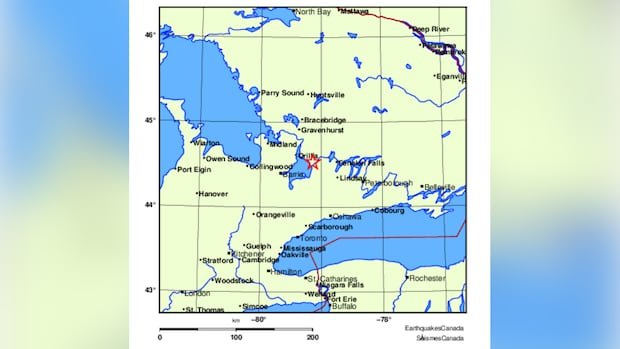

Thousands of individuals residing in southern and central Ontario reported being startled by an earthquake that occurred late Tuesday night, as per information from Natural Resources Canada. A magnitude 3.7 quake was recorded by Earthquakes Canada, situated approximately 99 kilometers northeast of Toronto just before 11 p.m. ET.
The seismic event, described as “lightly felt,” had its epicenter 23 kilometers southeast of Orillia, Ont., with a depth of five kilometers, according to the agency. Natural Resources Canada seismologist Marikah Adams mentioned that around 2,600 people have already reported feeling the earthquake, with reports coming in from as far as Kingston to Kitchener.
Sarah Cowley, an artist based in Beaverton, recounted experiencing a “roaring sound” reverberating through her century-old home when the earthquake struck. Despite the significant shaking of the floors, Cowley observed no visible damage upon inspection.
The earthquake’s effects were felt by individuals across a wide area, with at least 2,000 reports submitted through the site’s “Did you feel it?” link, ranging from Kitchener in the west to Belleville in the east and down to Niagara Falls in the south.
Although there were no immediate reports of damage or injuries, historical data from Earthquakes Canada indicated that the region had previously encountered earthquakes of similar magnitude, with the most substantial recorded quake being a magnitude 5.5 in 1929.
Explaining the unusual seismic activity in the area, Adams highlighted that it is not typical for intraplate regions within the North American plate to experience earthquakes. The cause of such events is less understood compared to plate boundary regions, with potential triggers including regional stress fields or reactivation of old buried faults along zones of crustal weakness.
Lindsay Schoenbohm, a geologist at the University of Toronto, suggested that pressure accumulation near old faults or buried cracks in the tectonic plate could lead to the release of energy in the form of small earthquakes, termed “snap, crack, pop earthquakes.”
Emphasizing the importance of earthquake preparedness, Adams advised individuals to follow safety protocols such as “stop, drop, cover, and hold on.” Contrary to previous beliefs, standing under a doorway is no longer recommended during an earthquake, as highlighted by Schoenbohm, who underscored that every seismic event offers valuable insights for scientists to enhance future predictions.
Social media users noted the recent earthquake as another challenge for the region, which has been grappling with extreme weather conditions. For Cowley, the events served as a reminder of nature’s power and the importance of being prepared for unforeseen circumstances.
Regarding discrepancies in earthquake reports, the U.S. Geological Survey (USGS) recorded the event as a magnitude 4.1 earthquake at a depth of 11.5 kilometers, slightly differing from Earthquakes Canada’s data. According to Natural Resources Canada seismologist Stephen Crane, variations in reports could stem from different monitoring stations or magnitude scales utilized.
Crane affirmed that Earthquakes Canada is the primary source for earthquake information within the country, emphasizing its reliability for residents seeking accurate and relevant updates. CBC News sought comments from the USGS to provide additional insights on the matter.