

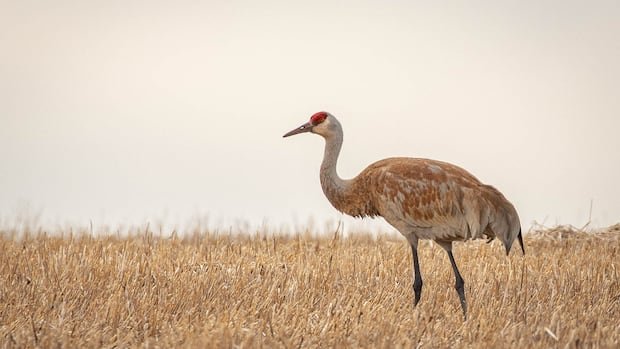

The federal government is considering allowing the hunting of sandhill cranes in northern Ontario, potentially starting this fall. The Canadian Wildlife Service has put forth a proposal for a limited hunting season in specific northern areas, marking the first time that sandhill cranes could be legally hunted in Ontario.
After years of advocacy from hunters and farmers citing crop damage caused by increasing crane populations, the proposal has been developed. Christopher Sharp, a population management biologist with the Canadian Wildlife Service, mentioned that data collection on sandhill cranes in Ontario and Quebec, including migration patterns and conflicts with farmers, has facilitated the evaluation process.
Sandhill cranes in Canada consist of two main populations. The eastern population in Ontario and Quebec, totaling around 100,000 birds, has notably expanded in recent decades, reaching levels suitable for sustainable harvesting. This positive trend contrasts with the species’ near-extinction in the late 19th and early 20th centuries due to unregulated hunting and wetland destruction.
The proposed hunt would be limited to regions in northern Ontario where sandhill cranes are most abundant during fall migration, such as Algoma, Nipissing, Temiskaming, and areas south of Sudbury, including the Hudson and James Bay District. The suggested two-week hunting season would restrict hunters to harvesting one crane per day in designated farmland areas to prevent disturbance to cranes roosting in the boreal forest.
Interest in hunting sandhill cranes is expected to be moderate but consistent, with some hunters referring to the bird’s meat as the “ribeye of the sky” due to its quality. The proposed hunting regulations aim to ensure sustainability and require hunters to hold both a provincial small game license and a federal migratory bird hunting permit. Public feedback on the proposed hunting season is welcomed until February 12.