

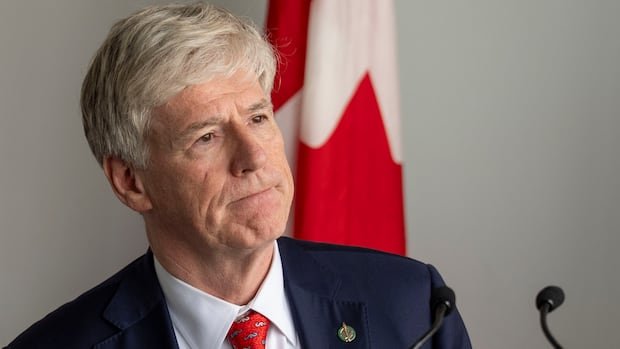

Ahead of the upcoming announcement of Prime Minister Mark Carney’s climate competitiveness plan, Energy Minister Tim Hodgson provided insight into what can be expected in the upcoming budget presentation on Tuesday. Hodgson shared details during discussions with officials and fellow G7 environment and energy ministers prior to the official commencement of the two-day G7 meeting in Toronto on Thursday.
Although not directly referencing the climate strategy, Hodgson discussed three key approaches guiding the government’s efforts. One approach involves strategically utilizing public funding and tax incentives to mitigate risks and encourage investments in innovative projects. The objective, as outlined by the minister, is to ensure the Canadian economy remains competitive and that Canadian products can excel in a low-carbon global environment.
Hodgson highlighted the potential for government funding to support the growth of Canada’s expanding carbon capture, storage, and removal sector. He referenced the partnership between Canadian company Arca and Microsoft, which aims to extract carbon dioxide from the atmosphere, with financial backing from NorthX Climate Tech, an organization supported by Natural Resources Canada.
Additionally, Hodgson emphasized Ottawa’s commitment to establishing a regulatory framework that provides industry with certainty through consistent policies, expedited timelines, and reliable permitting processes. The government is in the process of implementing legislation to streamline approvals for significant resource projects.
Furthermore, Hodgson emphasized the utilization of artificial intelligence (AI) to enhance energy systems, making them more efficient, responsive, and resilient. AI technology is already transforming energy production, distribution, and consumption by enabling real-time demand forecasting, enhancing material discovery for advanced batteries, and optimizing renewable energy sources like wind farms.
Regarding the government’s climate competitiveness strategy, a senior federal source indicated that the incentives for clean tech innovation and regulatory stability are integral components. However, there was no mention of the proposed industrial emissions cap in Hodgson’s statements. Notably, the budget release date coincides with the one-year anniversary of the government’s proposal to impose strict emission limits on the oil and gas sector, which contributes significantly to Canada’s overall emissions.
Former federal climate policy advisor Louise Comeau suggested that the government’s focus may shift towards supporting carbon capture and storage initiatives over implementing emission caps. Carbon capture technology, though still in experimental stages, is seen as a potential solution for industries like cement, steel, and oil and gas to reduce emissions while maintaining or expanding production.
Hodgson also highlighted various initiatives led by Ottawa in the realm of low-carbon energy generation, including nuclear plant extensions, small modular reactors, advancements in natural gas with carbon capture and storage, and the integration of grid-scale battery storage solutions.
The Canadian Climate Institute’s recent analysis indicates that Canada is unlikely to meet its 2030 emission reduction targets, which aim for at least a 40% decrease from 2005 levels. Current projections suggest that Canada may fall short of these goals, despite the government’s greenhouse gas reduction objectives. Changes under Prime Minister Carney’s administration, such as the cancellation of the consumer carbon pricing mechanism and the pause on the electric vehicle mandate, have raised concerns about achieving emission reduction targets.
As the government prepares to unveil its climate competitiveness strategy, focus remains on fostering innovation in clean technologies, establishing regulatory certainty, and leveraging advanced technologies like AI to drive sustainable energy solutions and enhance Canada’s position in a low-carbon economy.