

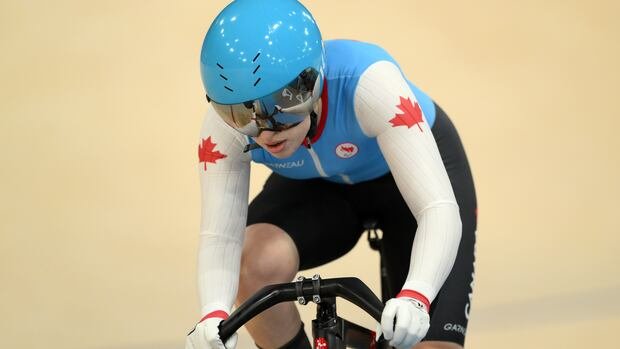

Para cyclist Mel Pemble, hailing from Victoria, achieved remarkable success at the recent world championships in Rio de Janeiro, securing four new world championship medals, including a gold in the sprint event. Despite a disappointing fourth-place finish at the 2024 Paris Paralympics, Pemble rebounded with her most successful medal haul at the world championships, setting her sights on the upcoming L.A. 2028 Games.
Competing in the C-class due to cerebral palsy affecting her right side, Pemble excelled in the sprint and elimination events added to this year’s championship. She clinched the sprint title, marking her eleventh world medal and a historic achievement. Pemble expressed her exhilaration at winning the title and bringing glory to Canada, describing the experience as a mix of relief and excitement, with tears of joy flowing on the podium.
The victory in Rio served as redemption for Pemble, who narrowly missed a Paralympic medal in Paris by a mere 0.3 seconds. Transitioning from alpine skiing to cycling three years ago, Pemble has shown resilience and adaptability, excelling in both track and road cycling at the Paralympic level. Her success at the world championships, winning four titles and a total of eleven medals, reflects her rapid progression in the sport.
Looking ahead to L.A. 2028, Pemble is focused on diversifying her events, aiming to compete in multiple disciplines. Her coach, Sébastien Travers, highlighted her enhanced commitment and maturity since training at the Bromont velodrome in Quebec. Pemble’s mental approach at the recent world championships was notably calmer, resulting in a successful performance across various events, including silver and bronze medals.
With a renewed sense of purpose and a revamped training regimen emphasizing endurance, Pemble is eager to tackle new challenges in the lead-up to the 2028 Paralympic Games. Travers outlined a strategic plan to optimize Pemble’s performance by targeting non-factored events in L.A., aligning her competition with athletes in similar impairment classes. The shift in training methodology represents a significant change, akin to a sprinter transitioning to longer distances, demonstrating Pemble’s capacity to excel in evolving circumstances.